
There’s something profoundly poetic about a textile that once held the literal “bread of life” for a family in Transylvania, now finding a second life on a sofa in Amsterdam, Berlin or London. These antique grain sack cushions aren’t just decorative objects. They are bridges between a rugged European past and a considered, curated present.
At Medreana, we don’t just see cushion covers. We see history, craftsmanship and authentic stories woven into every stripe. Whether you’re a collector of vintage textiles or just discovering the world of European grain sacks, this guide will help you understand, authenticate, style and care for these timeless pieces.
Table of Contents
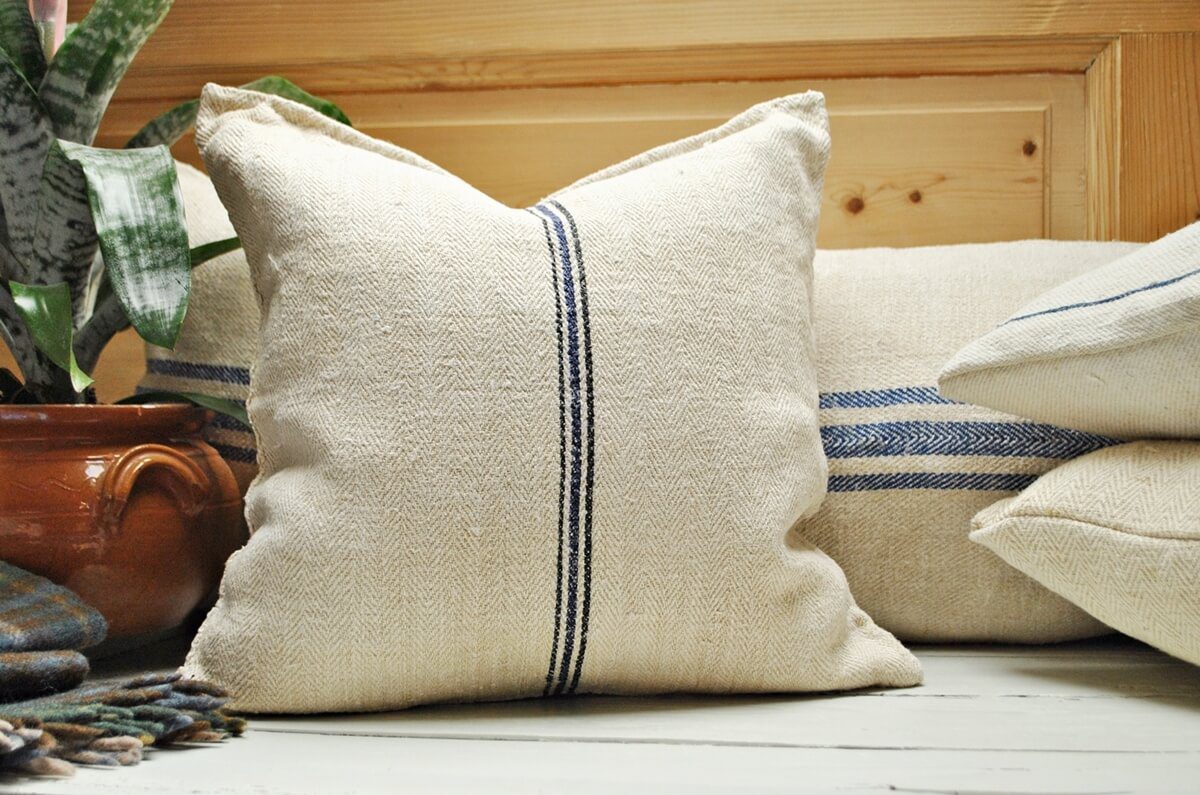
What Are Grain Sack Cushions?
To understand the grain sack cushion, you must first imagine the rolling hills of 19th-century Europe. Long before plastic containers or mass-produced synthetic bags, farmers relied on hand-loomed textiles to transport their harvest to the local mill. These were the workhorses of the homestead: heavy, durable hemp fabric built to withstand decades of agricultural use.
The European Heritage Connection
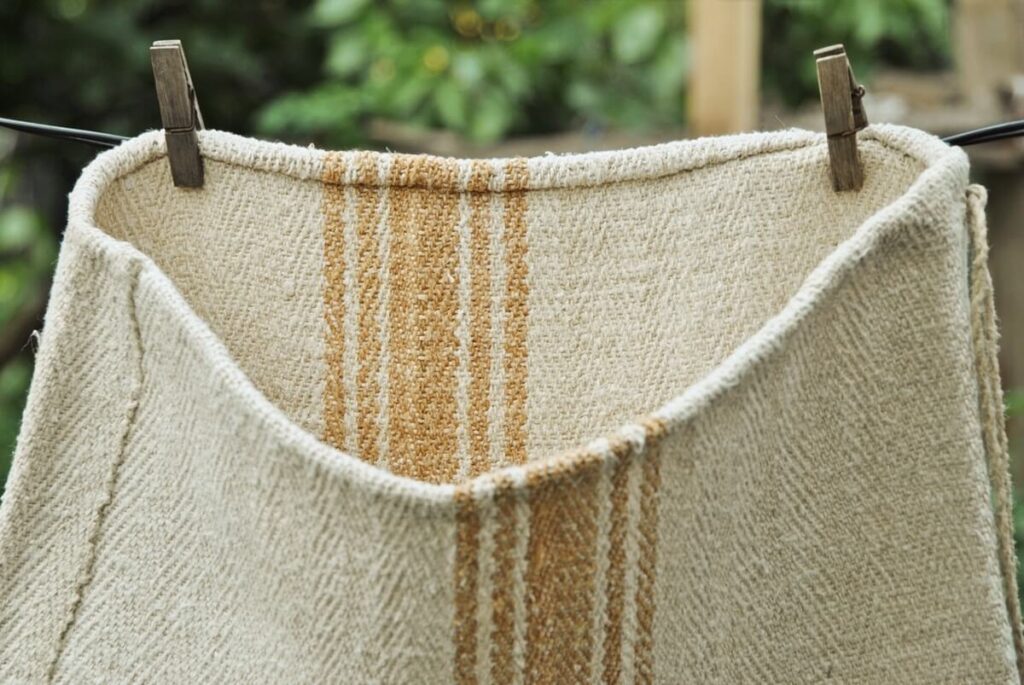
In regions like Transylvania, these grain sacks were more than utility items – they were a reflection of the household. Woven by women during the long winter months using homegrown hemp, each sack was a labor of love. When you hold a Medreana cushion today, you’re touching fabric that was likely woven on a wooden loom over 100 years ago.
These authentic textiles carry the “DNA” of the land. They’ve survived decades of hard labor, countless washings in cold river water and the passage of time. The characteristic stripes were never merely decorative – they served as family signatures, allowing farmers to identify their property at communal mills during busy harvest seasons.
Why Grain Sack Cushions Belong in the modern Home
Why is a utilitarian farm object now at home in the finest interiors in Europe? It’s the perfect intersection of soul and durability. In an era of “fast furniture”, collectors and design lovers are starving for authenticity. A grain sack cushion offers a tactile story that mass-produced décor simply cannot replicate.
The heavy weave provides a grounded, organic texture that softens the clean lines of contemporary homes. These antique cushion covers bring an effortless, lived-in quality that suggests the home has been curated over generations rather than purchased from a catalog in a single afternoon. It’s not just a cushion – it’s a piece of history you’re allowed to lean on.
Types of Grain Sack cushions: A Complete Breakdown
Not all grain sack cushions are created equal. Understanding the distinctions between types helps you make informed choices and appreciate the unique character of each piece. Here’s everything you need to know about European grain sacks by origin, pattern and size.
BY ORIGIN
Grain Sack Pillows by Origin
- French Grain Sacks – Often made of finer linen, French grain sacks are known for their softer hand-feel and elegant, muted stripes – frequently in shades of “French Blue” or soft red. These feature stencilled or embroidered markings indicating the mill, farm or region.
- German Grain Sacks – These tend to be heavier and are prized for their beautiful oatmeal and grey tones. German and belgian linen is world-renowned for its quality and vintage german sacks reflect that prestige. The colors tend toward deeper blues and rustic reds, sometimes with multiple stripe patterns on a single sack.
- Transylvanian Grain Sacks (The Medreana Specialty) – These are the hidden gems of Eastern Europe. Typically woven from hemp, Transylvanian grain sacks are incredibly durable and feature a coarser, more “primitive” texture. The stripes are bold and unique, reflecting the specific weaving patterns of a particular village or family. What makes these Romanian textiles particularly special is their connection to a way of life that remained relatively unchanged for centuries. These are the cushions we specialize in at Medreana. Each piece is hand-sourced directly from Transylvania and restored with care. This is not inspired by tradition. This is tradition. → Browse Authentic Transylvanian Grain Sack Pillows on Etsy
BY STRIPE PATTERN
Understanding Grain Sack Stripe Patterns
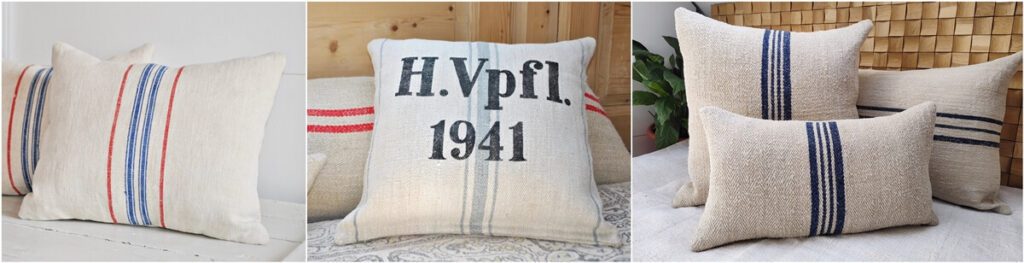
The stripes weren’t for decoration – they were the farmer’s “ID tag.” When twenty farmers took their grain to the mill, the stripes ensured they got their own sacks back. Today, these patterns give each antique cushion its distinctive character.
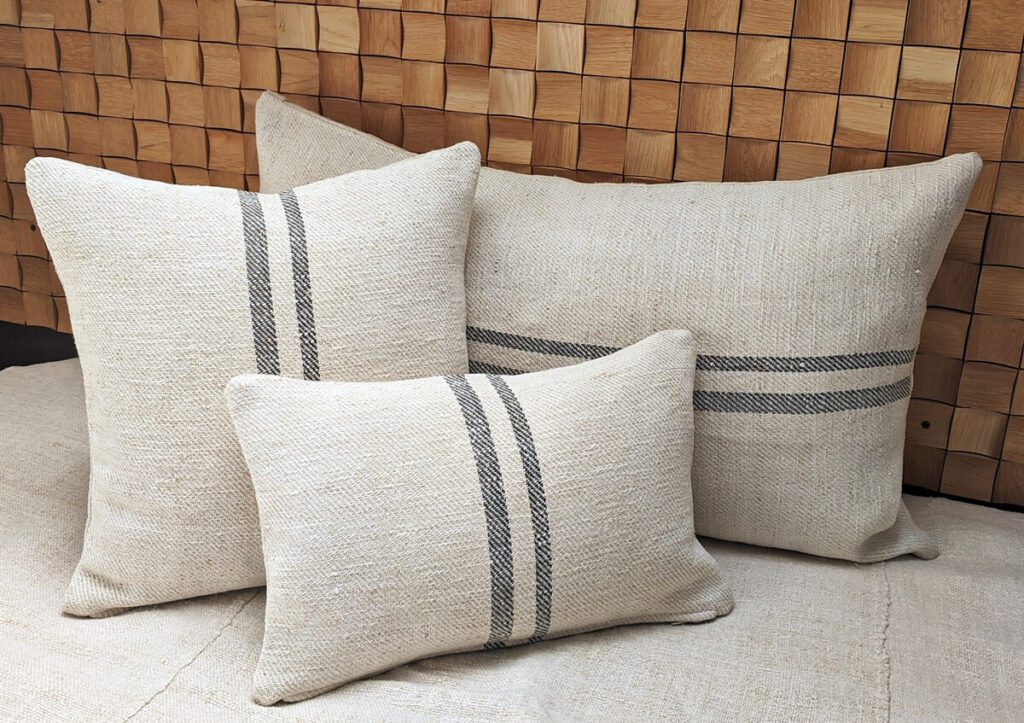
- Single Stripe – Minimalist and modern. Usually centered, a single bold stripe creates a strong focal point without competing with other patterns in your space. These work beautifully in Scandinavian-inspired interiors or anywhere you want texture without busy patterns.
- Double Stripes – A classic look that feels balanced and traditional. This is perhaps the most common and recognizable grain sack pattern. The spacing between stripes varies by origin: French versions often have wider spacing, while Eastern European sacks might show closer parallel lines.
- Multi-Stripe – Often featuring varying widths and colors, these are rare and highly sought after for their complex, graphic appeal. Multi-stripe sacks make bold statement pieces and work particularly well as focal points on sofas or beds.
BY SIZE
Grain Sack Pillow Sizes: Which is Right for You?
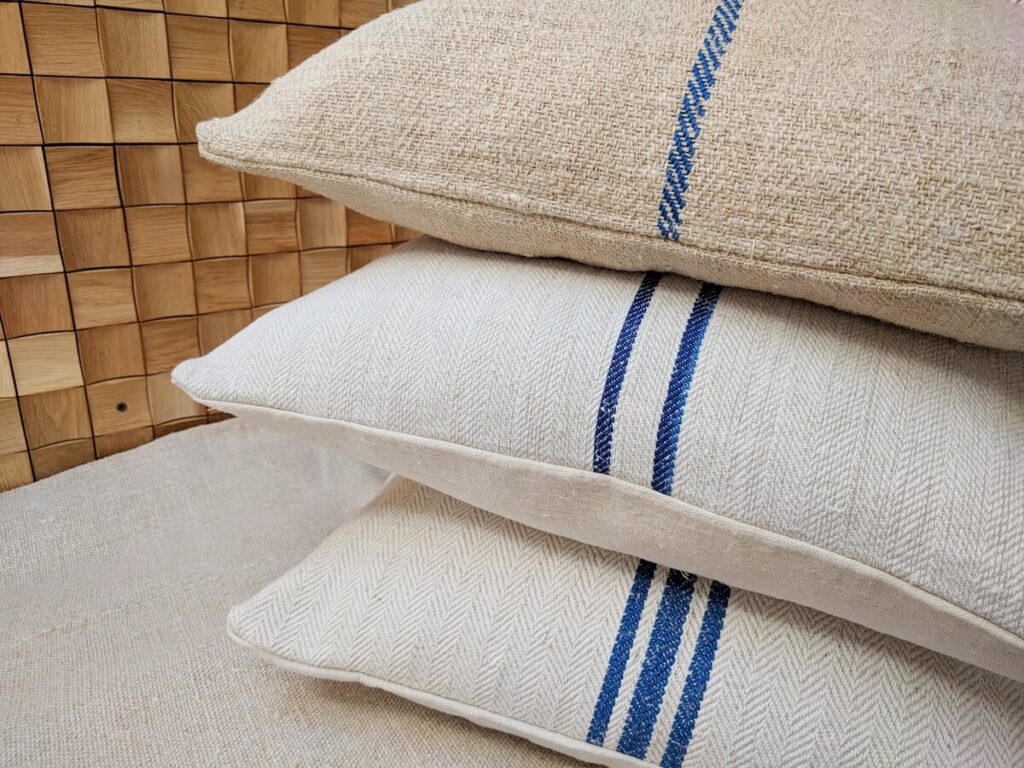
- Lumbar Cushions (30x50cm to 60x40cm / 20×12 to 26×16 inches) – Perfect for armchairs or as the “finishing touch” in front of bed cushions. Their elongated proportions showcase the horizontal stripe patterns beautifully, making them ideal for layering on sofas or benches.
- Square Cushions (40x40cm to 50x50cm/ 14×14 to 20x20inches) – The standard for sofas. Large enough to show off the verticality of the stripes and provide comfortable support. These work well as standalone statement pieces or as anchors in layered cushion arrangements.
- Large Lumbar / Long Shams (75x48cm to 90x49cm / 30×20 to 36×20 inches) – These massive pillows are ideal for headboards, providing a rustic backdrop for finer bedding. Big sized grain sack cushions work beautifully as back pillows in bed styling, providing both comfort and dramatic visual impact.
Shop Grain Sack Cushion Covers – Handwoven Hemp
How to Style Grain Sack Cushions: 4 Designer-Approved Looks
The beauty of antique grain sack cushions lies in their remarkable versatility. These humble textiles transition seamlessly between design styles, anchoring rustic schemes while elevating minimalist spaces. Here’s how to incorporate grain sack decor into four popular aesthetics.
LOOK 1
1. Wabi-Sabi & Slow Living
This is the natural habitat of the grain sack cushion. The philosophy of wabi-sabi, finding beauty in imperfection, in age, in the handmade – is exactly what these textiles embody. The slightly uneven stripes, the irregularity of hand-spun hemp, the patina of a hundred harvests – these are not flaws. They are the point.
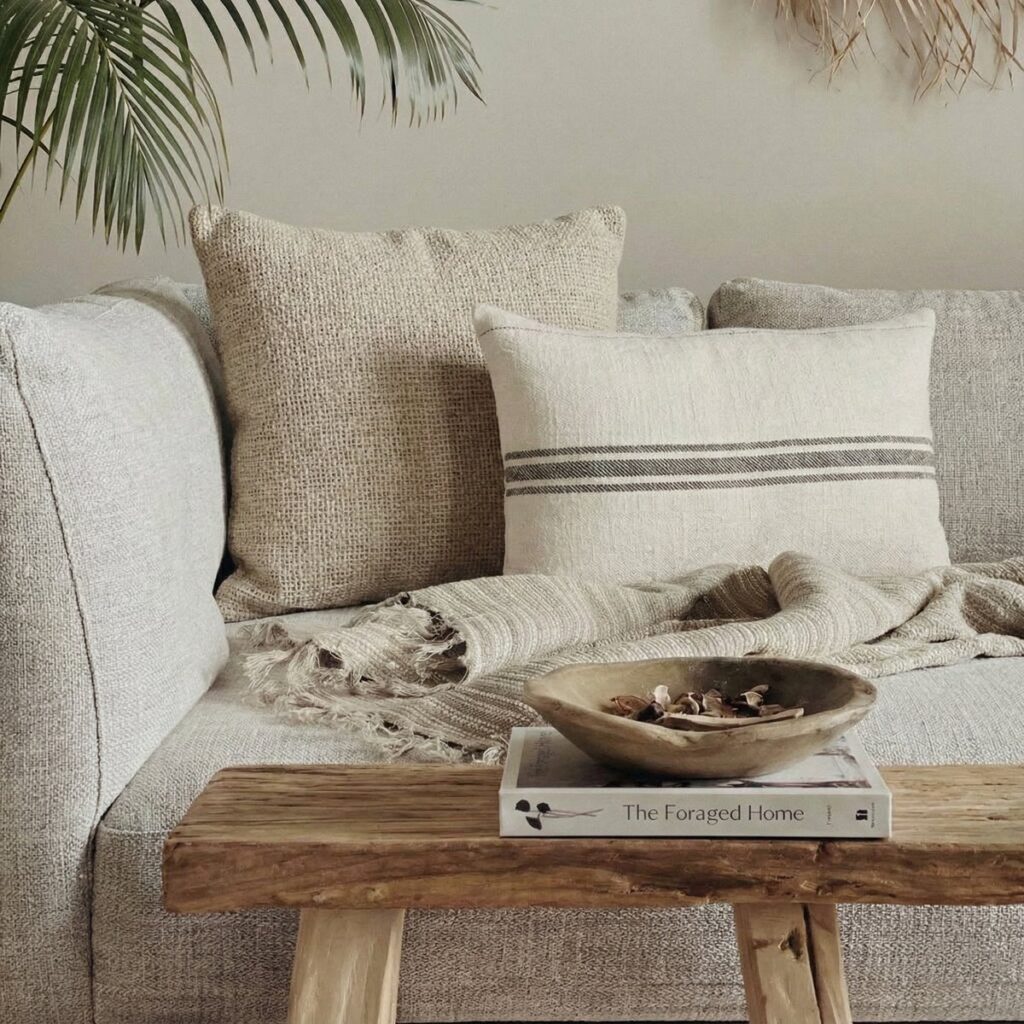
The Styling Tip: Pair a bold charcoal or indigo-striped grain sack cushion cover with a natural linen sofa.The contrast between rough hemp and the soft linen creates the layered texture that defines the wabi-sabi interior. Add a single dried botanical arrangement and a worn wooden bowl. Nothing more is needed.
In the bedroom, place a grain sack lumbar cushion against undyed linen bedding. The juxtaposition of the antique textile against clean white linen captures the slow living aesthetic without effort – aged and new, imperfect and simple, coexisting exactly as they should.
Medreana recommends: cushion covers with visible stripe irregularities, indigo ombré dip-dye or single thin stripes in charcoal or grey.
LOOK 2
2. English Country House
The English country house interior is built on a philosophy of accumulation over time – nothing was ever chosen from a single catalogue, and that is precisely its charm. Oak beams, flagstone floors, a cast iron log burner, linen sofas worn soft by years of use. Into this world, a grain sack cushion cover from Transylvania fits as naturally as if it had always been there.
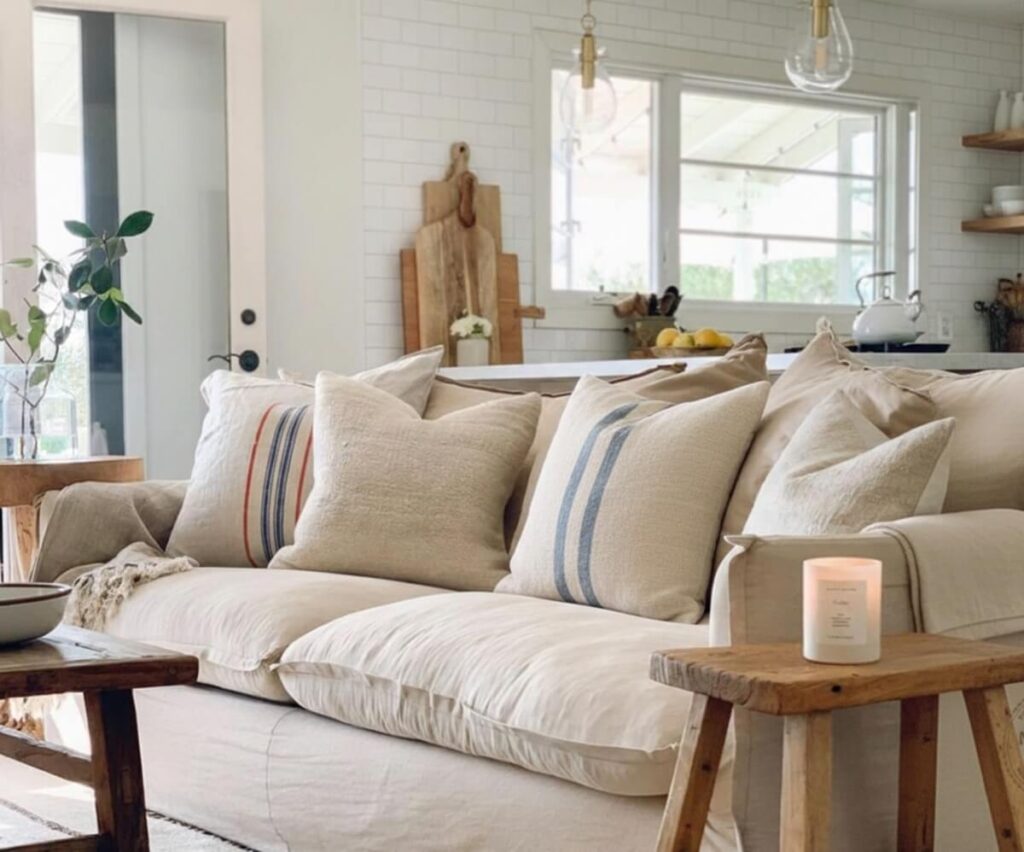
The Styling Tip: Layer a grain sack lumbar cushion cover in natural oatmeal hemp with indigo blue stripes against a loose-covered linen sofa. Add a wool throw in warm oatmeal. Keep the arrangement slightly imprecise – one cushion angled, the throw casually draped. English country interiors distrust perfection. On the bed, centre a large grain sack lumbar cushion cover against a white painted headboard with crisp white linen beneath. A bare branch in a clear glass vase to one side. Diffused grey light from a deep-set sash window. The effect is quietly extraordinary.
Medreana recommends: lumbar formats in oatmeal hemp with single or double indigo blue stripes, or bold red stripes for Szekely Collection pieces.
LOOK 3
3. French Country Cottage
The French have a word for it dépaysement , that feeling of being transported somewhere else entirely. A French country cottage interior does exactly this: stone floors worn smooth by centuries, plaster walls in the palest cream, linen curtains moving in warm afternoon air. Antique textiles are not decoration here. They are evidence of a life lived well and slowly.
The Styling Tip: Pair grain sack cushion covers in faded red or soft blue stripes with a linen sofa in warm oatmeal or aged white. The palette should feel sun-bleached, nothing too saturated, nothing too new. Add a terracotta pot of dried lavender and a worn wooden tray on the coffee table. In the dining room, place a grain sack lumbar cushion cover on a painted wooden chair at a long farmhouse table set simply with linen napkins and earthenware. The informality is intentional. French country style is elegant precisely because it does not try to be.
Medreana recommends: cushion covers with faded red stripes on natural oatmeal hemp, or soft burgundy and cream combinations from the Valley Collection.
LOOK 4
4. Mediterranean Farmhouse
From the sun-bleached farmhouses of Provence to the whitewashed masserie of Puglia, the stone fincas of Mallorca and the ancient konobe of Dalmatia — Mediterranean interiors share a common language. Thick walls that hold the cool. Terracotta floors warm from the afternoon sun. Objects that have survived generations because they were made to last. A grain sack cushion cover, woven from hemp a century ago in Transylvania, speaks this language fluently.
The Styling Tip: Place grain sack cushion covers in warm natural oatmeal with coral or terracotta stripe accents on a stone bench or a simple linen sofa positioned to face a garden or terrace. The contrast between the rough-textured hemp and the warm stone or plaster backdrop is the entire composition, no further decoration required. On a terrace, arrange grain sack lumbar cushion covers on wooden or wrought iron chairs alongside terracotta pots, olive branches and simple ceramic vessels. The grain sack’s natural oatmeal tone reads as warm and earthy under Mediterranean light in a way it does nowhere else.
Medreana recommends: overdyed coral cushion covers from The Dyed Collection, or natural oatmeal hemp with warm red or burgundy stripes from the Heritage Collection.
Each piece in the Medreana collection is hand-woven circa 1900 and one of a kind. When a cushion cover is gone, it cannot be remade. Browse the current collection at medreana.etsy.com
How to Identify Authentic Grain Sacks vs. Reproductions
As grain sack cushions have surged in popularity, the market has been flooded with “grain sack style” reproductions. While there’s nothing inherently wrong with reproduction fabric if it’s sold honestly, understanding how to identify authentic vintage pieces protects you from overpaying and ensures you’re getting the genuine article when authenticity matters to you.
| Feature | ✅ Authentic Vintage | ❌ Reproduction |
| Texture | Irregular, with small lumps (slubs). Feels substantial and slightly rough. | Perfectly smooth and uniform. Machine-made precision. |
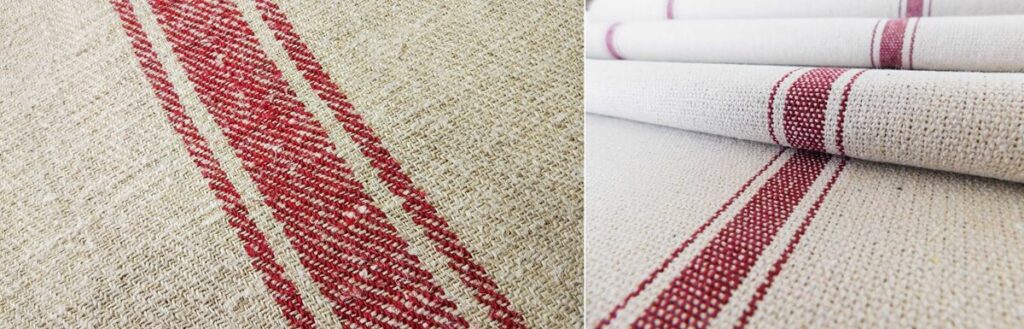
| Stripes | Woven into the fabric. Visible on both sides when you flip it. | Printed on top. Stripe fades or disappears on the reverse. |
| Stripe edges | Slightly fuzzy / blurred where colors meet. | Crisp, sharp edges — too perfect. |
| Condition | Shows age: faded areas, small hand-mended repairs, fold marks. | Pristine or artificially distressed in a uniform pattern. |
| Smell | Neutral or a faint hint of dried hay after cleaning. | Chemical or “new polyester” smell. |
| Price | €75–€130 for a quality authentic piece. | Under €50 is a clear sign of reproduction. |
Texture – What Authentic Hemp Feels Like
Genuine antique hemp has “slubs” – tiny lumps and irregularities in the weave where the hand-spun thread varies in thickness. If a fabric feels perfectly smooth and uniform, it’s almost certainly a modern machin-made reproduction. Authentic grain sack fabric has “weight” to it; it feels substantial, almost like a heavy canvas, but with the breathability of a natural fiber.
Run your hand across the fabric – genuine antique linen has slight variations in thickness, occasional slubs and a texture that’s simultaneously sturdy and slightly softened by age. Modern reproductions, even high-quality ones, tend toward mechanical perfection with precisely uniform weaving throughout.
Stripes – Woven vs. Printed
On an authentic sack, the stripes are woven into the fabric, not printed on top. If you flip the fabric over and the stripe doesn’t show through or looks different, it’s a print. Woven stripes have slightly soft edges where the colored thread meets the natural hemp ground.
Look closely at the stripe edges – they should be slightly blurred, not crisp. The dye penetrates the individual threads, so you’ll see color variation within the stripe itself. Original stripe colors were typically dyed with indigo (blue), madder or iron oxide (red/rust) or carbon (black/charcoal). These dyes fade in characteristic ways: blues may shift toward gray or softer denim shades, reds toward warm rust tones.
Patina – Reading the history
Look for evidence of a life lived. This might include small, neat mends (darnings) made by the original farmwife or slight variations in color where the sun hit the fabric. Authentic antique hemp often has a warm, slightly creamy or ivory tone rather than stark white. This isn’t dirt – it’s the natural aging of fibers over decades.
Authentic wear marks tell stories: stress marks along seam edges, thin spots where friction wore down the fabric, small holes or tears that were hand-mended, stains from grain dust or moisture and fold lines from being stored flat over many years. These imperfections are features, not flaws; they’re proof of authenticity and add character.
Red Flags When Buying
- Perfect condition is suspicious. A 100+ year-old working textile in pristine condition should raise questions. While some grain sacks survived in excellent condition due to careful storage, most show some evidence of their long life.
- Too-uniform distressing. Some reproductions are artificially distressed with tea-staining, strategic bleaching or intentional holes and tears. This distressing often looks too uniform or deliberate, real aging is random and tells a logical story of use.
- Chemical smell. Authentic grain sacks that have been properly cleaned should smell like nothing or perhaps a faint hint of dried hay. If it smells strongly of chemicals or “new” polyester, it’s a reproduction.
At Medreana, we have spent years learning to authenticate Transylvanian grain sacks and are always glad to share what we know.
For a complete buyer’s guide to identifying authentic pieces, read our Guide to Authentic Antique Grain Sack Pillows
How to Care for Antique Grain Sack Cushions
Proper care ensures your grain sack cushions remain beautiful for years to come. At Medreana, we’ve already done the hard work of deep-cleaning these textiles before they reach you. But life happens. These antique textiles have already survived a century; with thoughtful maintenance, they’ll continue their journey for generations. The natural fabric becomes softer with each wash while maintaining its durability.
Step-by-step guide for grain sack care
Washing Antique Grain Sack Cushions: Do’s and Don’ts
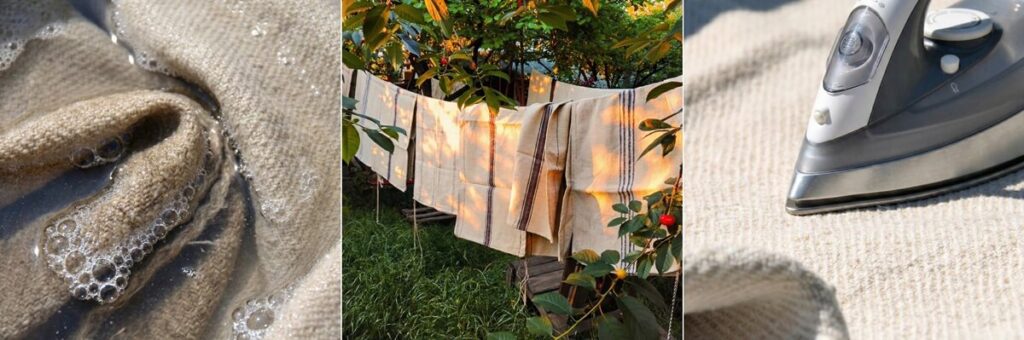
Most antique grain sack covers are machine washable – after all, they were built to survive the farm! Use a gentle cycle with cold water and a mild, bleach-free detergent. Never use high heat in the dryer; it can make the fibers brittle. Air drying is best.
- DO use cold water and gentle cycle. Low spin is crucial to prevent deep creases. Hot water can cause additional shrinkage and may set old stains more permanently. Use a pH-neutral detergent specifically designed for delicate fabrics, harsh modern detergents can be too aggressive for antique fibers.
- DON’T use bleach or harsh stain removers. These chemicals can damage the aged fibers and may cause the stripe dyes to run or fade unevenly. The slight staining and discoloration on your grain sack cushion is part of its authentic character, attempting to bleach it white destroys what makes it special.
Stain Removal for Grain Sack Fabric
For localized spills, spot clean with a damp cloth and a drop of clear dish soap. Because the weave is thick, stains tend to sit on the surface initially – act fast! For tougher stains, a paste of baking soda and water usually does the trick without harming the fibers.
Remember that some historical stains and discoloration are permanent parts of your pillow’s story. If a stain has been on the fabric for decades, it’s woven into its history. Aggressive stain removal attempts can cause more harm than good. Embrace these marks as evidence of the textile’s authentic journey.
Storage Tips
If you rotate your decor seasonally, store your grain sack covers in a breathable cotton bag. Avoid plastic bins, which can trap moisture and lead to mildew. Remember, these are natural fibers – they need to breathe!
Store covers flat or loosely folded rather than compressed. For very long-term storage, consider rolling covers around acid-free tubes rather than folding. Natural moth deterrents like lavender sachets or cedar blocks can protect against insect damage, but keep them from direct contact with the fabric.
Antique Grain Sack Cushions: Frequently Asked Questions
1. What are grain sack cushions made from?
Authentic grain sacks are made from hand-loomed hemp or a blend of hemp and cotton. At Medreana, we focus on high-quality Transylvanian hemp. The fabric is typically heavy-weight, handwoven from hemp fibers, chosen for its strength, durability and breathability – perfect for protecting grain during transport and storage.
2. How old are authentic grain sacks?
Most authentic grain sacks were produced between 1850 and 1950. After the 1950s, industrialization led to the use of cheaper, machine-made burlap and paper. The grain sacks available today typically date from the mid-1800s through the early-to-mid 1900s, making them between 100-170 years old.
3. Why do grain sacks have stripes?
The stripes were family signatures. They allowed farmers to identify their property at the communal mill. Each farm or mill had distinctive stripe patterns woven into their sacks, making it easy to sort and return bags to their owners during busy harvest seasons.
4. Are grain sack cushions washable?
Yes! Because they are natural plant fibers, they are quite hardy. Use cold water, gentle cycle and mild detergent. Just avoid bleach and high heat. The natural fabric becomes softer with each wash while maintaining its durability.
5. How much do authentic grain sack cushions cost?
Prices vary based on rarity and condition. Expect to pay between $85 and $175 for a high-quality, authentic pillow. If you see one for $20, it’s almost certainly a reproduction. Genuine antique grain sack cushions command premium prices due to scarcity and the labor involved in sourcing and restoring them.
6. Where can I buy authentic grain sack pillows?
Specialty shops like Medreana are your best bet, as we source directly from Europe and handle the restoration process ourselves. Look for sellers who specialize in European vintage textiles and can provide detailed information about origin and condition.
7. Do grain sack pillows shed or smell?
High-quality, cleaned vintage hemp does not shed. Unlike burlap (which is made of jute), hemp and linen are long-staple fibers that stay intact. Properly cleaned grain sack pillows should smell neutral or perhaps have a faint, pleasant hint of dried hay.
8. How long do grain sack pillows last?
If cared for, they will literally last a lifetime. They have already survived 100 years; with a little love, they’ll survive 100 more. With proper care, these antique grain sack pillows can last for many more decades beyond their already century-long life.
A Final Word
Each Medreana grain sack cushion has already lived one full life – grown, retted in rivers, woven by hand, used through harvest after harvest, stored in a chest and forgotten. We found it. We restored it. We made it into something you can live with every day.
The beauty of antique hemp textiles lies precisely in their imperfections: the uneven weave, the faded stripes, the hand-stitched repairs. Care preserves these details rather than erasing them.
This is not inspired by tradition. This is tradition.
Leave a Reply