
In this Guide:
There’s a version of a grain sack pillow that costs $18 on Amazon. There’s another that costs $175 and sells out before it can be restocked.
They look similar in a thumbnail. They are not the same thing.
If you’re here, you already sense the difference. You want the real thing: a textile that survived a century of harvest seasons in a Transylvanian barn, not a machine-woven reproduction designed to look like one. This guide will show you exactly what separates the two and where to find the genuine article.
What an Authentic Antique Grain Sack Actually Is
To understand what you’re buying, you need to understand what these textiles were made for and how they were made.
Grain sacks were working objects. In rural Transylvania and across Central Europe, farming families used them to transport grain to the mill, store the harvest and carry provisions. They were not decorative. They were built to last decades of hard agricultural use.
The oldest sacks, from the early 1900s and before, are woven from 100% hemp in Transylvania and Central Europe, or 100% flax (linen) in France, Germany and further west. As industrialization progressed, blended fabrics appeared: a cotton warp (easier to work on the loom) combined with a hemp weft, which provided the durability the sack needed. These blends are still authentic antiques, just from a slightly later period.
What you will never find in a genuine antique grain sack is polyester. Or any synthetic fiber. Because polyester did not exist when these were made.
From Plant to Thread, By Hand
This is the detail that changes everything.
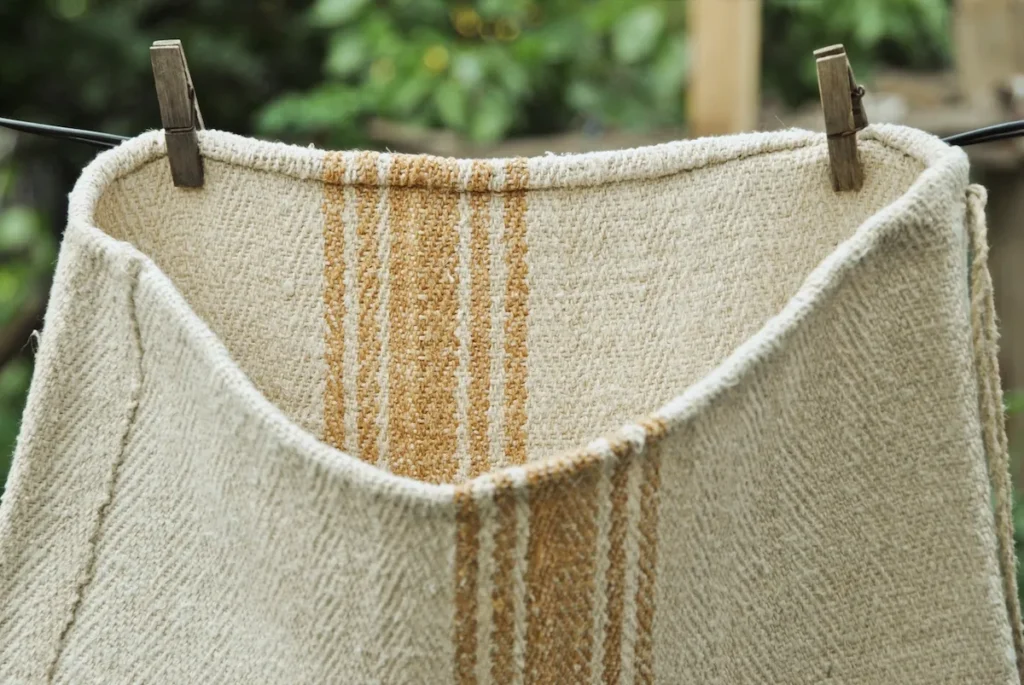
The women who made these textiles processed hemp entirely by hand, from the harvested plant to the finished thread. This process produced thread of varying thickness and regularity. The coarser, more uneven thread went into grain sacks, which were purely functional. The finer, more regular thread was reserved for towels, bed sheets and garments, textiles that also had to be beautiful. These finer fabrics were washed several times and bleached in the sun. Grain sacks were not, which is why some authentic antique grain sacks still carry their natural warm yellow tone and why you can sometimes find tiny flecks of plant stem embedded in the woven fiber.
That yellow is not dirt. It is the unbleached color of hand-processed hemp. It is one of the clearest markers of authenticity.
The Weave: What Reproductions Cannot Replicate
This is where authentication becomes technical and where the difference between authentic and reproduction becomes impossible to hide.
4-Shaft Twill: The Weave of Working Textiles
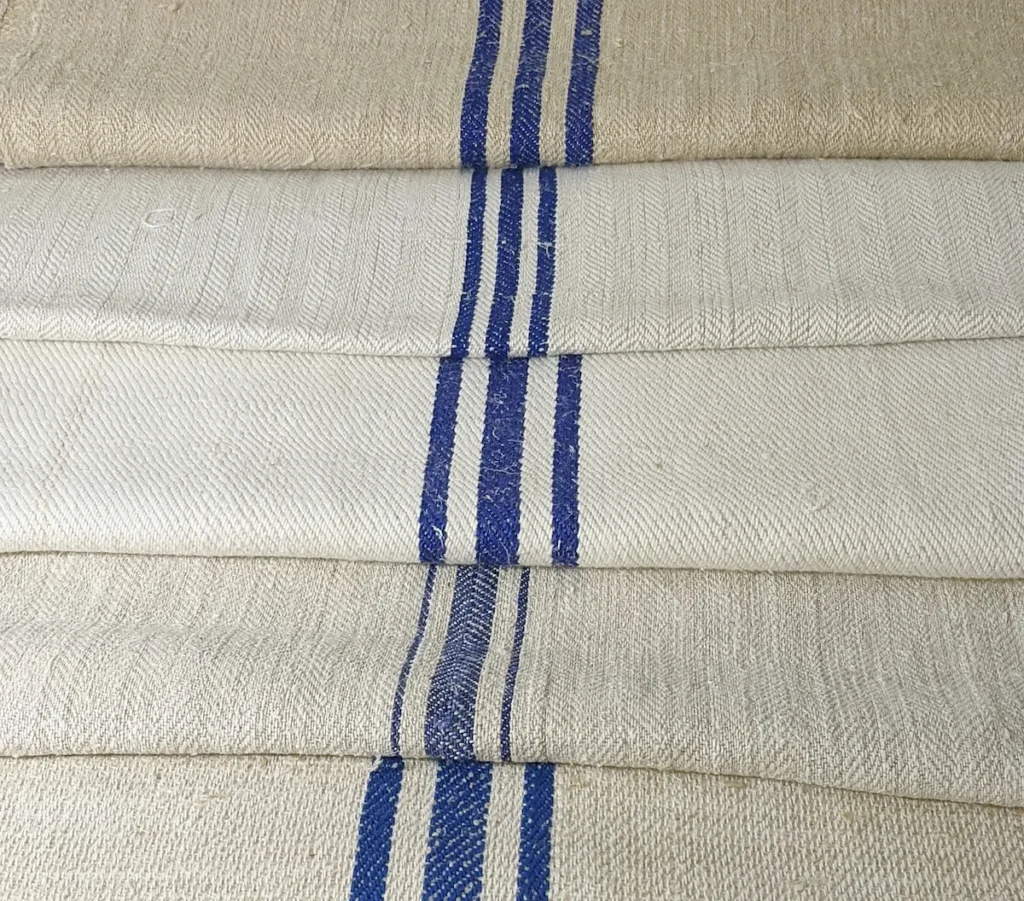
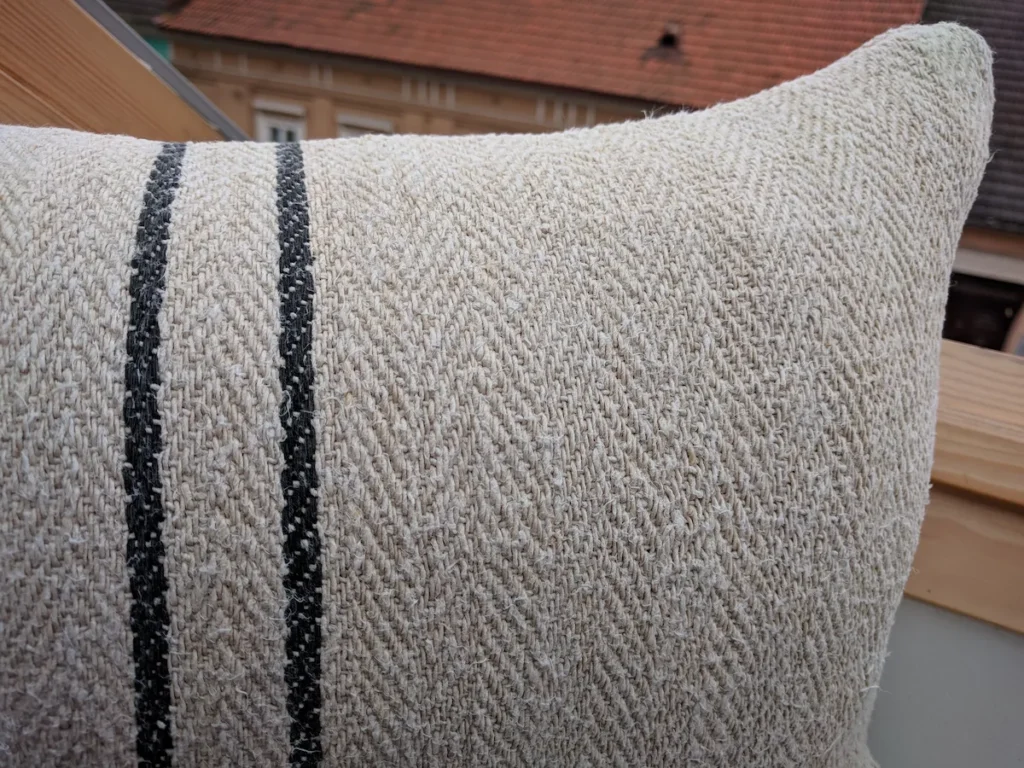
Authentic antique grain sacks are woven in 4-shaft twill, a weaving structure that requires a loom with four harnesses and considerably more skill than basic plain weave. It comes in two forms you’ll encounter in genuine pieces:
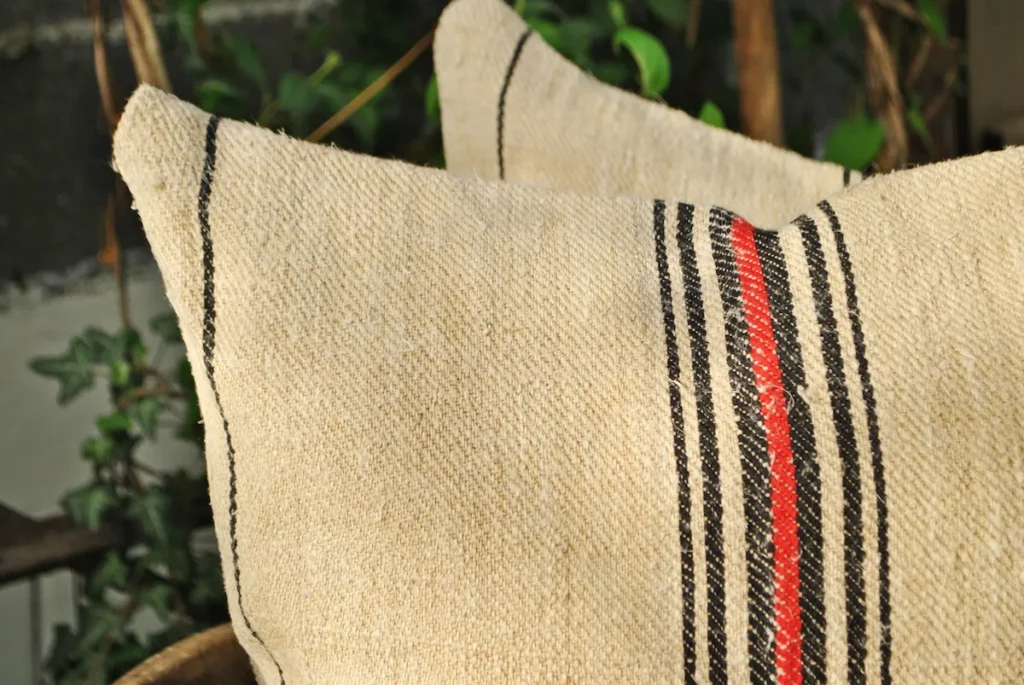
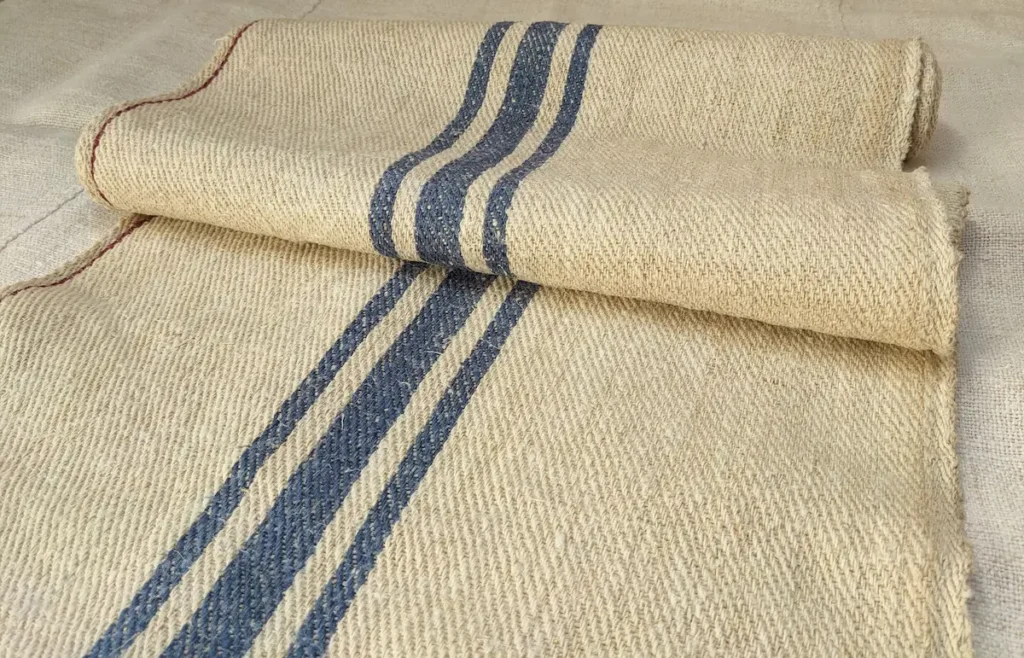
Diagonal twill: the weft thread passes over and under warp threads in a consistent diagonal pattern, creating the characteristic slanted lines visible on the fabric surface. Think of denim: that diagonal texture is twill. Antique grain sack twill is the same structure, far heavier, made from hand-spun hemp.
Herringbone twill: the diagonal reverses direction at regular intervals, creating a V-shaped zigzag pattern. Both diagonal and herringbone appear with equal frequency in genuine Transylvanian grain sacks.
Why did farming families weave their grain sacks in 4-shaft twill? Because it is structurally stronger than plain weave. The interlacing pattern distributes stress across more threads, making the fabric far more resistant to tearing under the weight of grain. These women were not making an aesthetic choice, they were engineering durability into the textile.
The result is a fabric that is substantially heavier and thicker than any reproduction on the market. A single antique grain sack weighs between 500g and 1kg. Hold a reproduction next to a genuine piece and the difference is immediate and unmistakable.
Plain Weave: The Finer Textiles
Not everything woven in the 1900s was a grain sack. The finer hemp thread, the thread that took more time to spin, was woven in plain weave (simple 1-over-1-under alternation) for towels, bed sheets and garments. These textiles were bleached in the sun, embroidered and designed to be both functional and beautiful.
At Medreana, we work with both: the coarser 4-shaft twill grain sacks and the finer plain weave textiles, each with their own character and history.
How to Recognize a Reproduction
Reproductions sold as “grain sack style” by honest retailers are clearly labelled and priced accordingly: $20 to $50, machine-woven from cotton or cotton-polyester blends, designed to evoke the aesthetic. There is nothing wrong with these if you know what you’re buying.
The problem is reproductions sold as authentic antiques. Here is how to tell them apart.
The Stripe Pattern
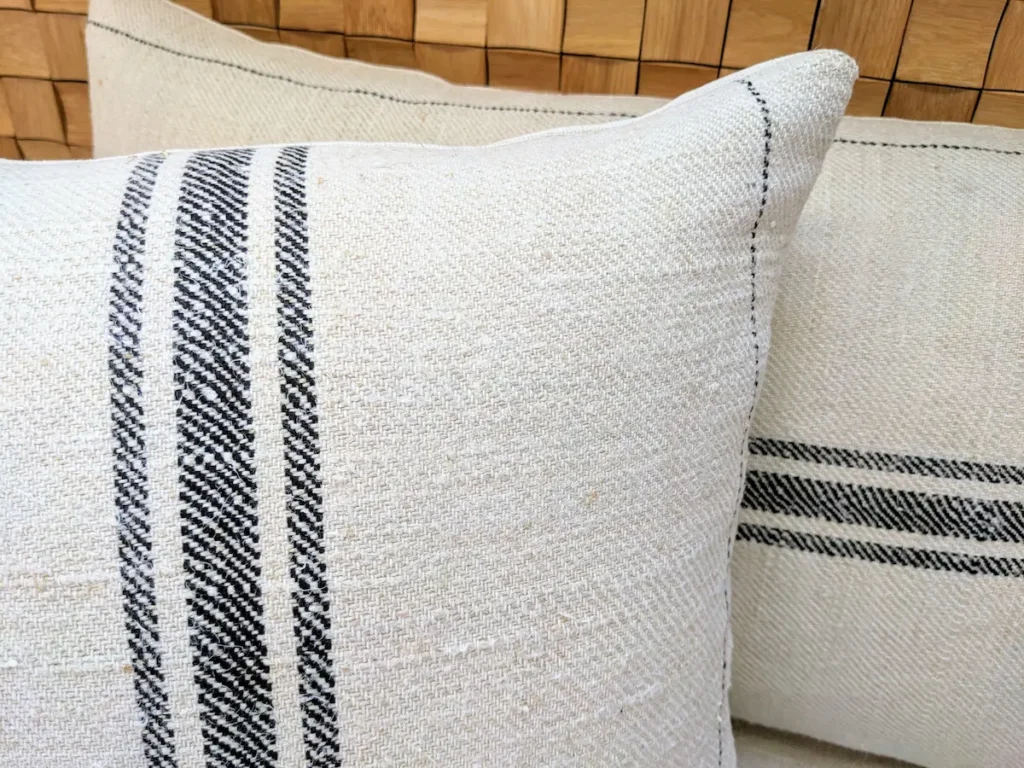
Reproduction grain sacks overwhelmingly use one pattern: a wide central stripe flanked by two narrower stripes on each side. This pattern has become the visual shorthand for “grain sack” in the mass market.
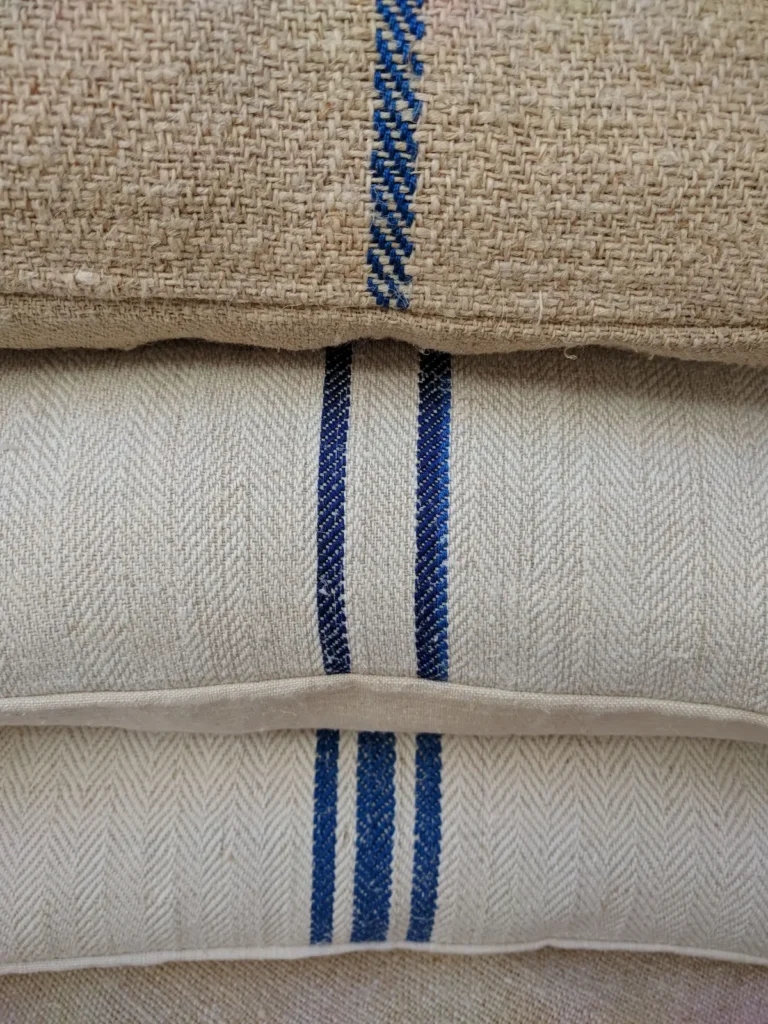
Authentic antique grain sacks show extraordinary variety. The stripe was the family’s identifier, their signature at the communal mill, their mark on their property. Every family had their own pattern. And the woman weaving the sack brought her own artistic sensibility to the work. The result is a vast range of stripe widths, spacings, color combinations and compositions that no two families and no two sacks share exactly.
Monotony is a reproduction signal. Variety is a mark of authenticity.
The Fiber
Run your hand across the fabric. Authentic hand-spun hemp has natural irregularities: variations in thread thickness, small lumps where the fiber bunched during spinning. The fabric feels substantial, slightly rough, alive with imperfection. You may notice the warm yellow of unbleached hemp and occasionally a tiny fleck of plant stem caught in the weave.
Machine-spun synthetic or cotton thread is perfectly uniform. Smooth. Consistent. It feels like upholstery fabric.
If the fabric feels like it was made by a machine, it was.
The Weave Structure
Look at the fabric at an angle. In a 4-shaft twill, you will see the characteristic diagonal lines running across the surface. The fabric will feel dense and heavy. Reproductions are typically woven in plain weave: flat, regular, with no diagonal pattern.
If the stripe is printed rather than woven into the structure, it will look different on the reverse: faded, absent or clearly applied to the surface. Woven stripes are structural: they appear on both sides.
The Weight
Pick it up. A genuine antique grain sack cover is heavy .This weight comes from the density of hand-spun hemp fiber and the structure of 4-shaft twill weaving. Reproductions are noticeably light. The difference is not subtle.
Why Authentic Antique Hemp and Linen Are Better for Your Home
This is not only about aesthetics or provenance. It is about what you bring into your living space.
Authentic antique hemp and linen are natural fibers in their truest sense, grown without synthetic inputs, processed entirely by hand, woven without chemical finishes or treatments. They do not off-gas. They do not shed microplastic particles into your home. They do not contain flame retardants, softening agents or dye fixatives applied in industrial finishing.
Contemporary reproductions, particularly those made from polyester blends or treated cotton, behave differently. Synthetic fibers shed microscopic plastic particles with every use and every wash. Industrially finished fabrics release chemical compounds over time. In a home where you breathe the air and touch the surfaces daily, this distinction matters.
A 120-year-old hemp grain sack is pure fiber, dense, durable, inert and genuinely natural in a way that no contemporary fabric, however marketed, can match.
For step-by-step washing and care instructions specific to antique hemp, see our complete grain sack care guide.
The farming women who wove these textiles were not thinking about indoor air quality. They were thinking about durability and function. But the materials they chose and the processes they used happen to align perfectly with what designers and health researchers now call salutogenic design, the principle of surrounding yourself with materials that support wellbeing rather than quietly working against it.
Provenance: The Question Every Authentic Seller Can Answer
Ask any seller you’re considering: Where exactly did this come from?
Not “Europe.” Not “Eastern Europe.” A specific country, region, valley or market. A verifiable period. A fiber content confirmed by testing, not assumed from appearance.
At Medreana, every piece is sourced directly from Transylvania, from specific villages, markets and regions we know personally. You can read the full story of how Medreana began and why these textiles matter on our story page. We confirm fiber content through burn testing: hemp and linen burn cleanly, leaving powdery ash and no chemical smell. Polyester melts. There is no ambiguity. Every listing carries this documentation: origin, period, fiber, weave structure.
A seller who cannot answer the provenance question specifically is a seller who cannot verify what they’re selling.
Where to Find the Real Thing
On Etsy, look for listings with detailed provenance, not “European vintage” but a named region and period. Read the full description. Ask questions before you buy. A specialist seller will welcome them.
Avoid mass retail platforms for genuine antiques. Amazon, Wayfair and large home decor retailers carry grain sack style products, sometimes honestly labelled, never authentic antiques.
Specialist sellers who source directly from Europe are your most reliable option, sellers who travel to find these pieces, who know the difference between a diagonal and herringbone twill, who can tell you why a particular sack is heavier than another and what the stripe pattern suggests about its origin.
At Medreana, we have been sourcing, restoring and selling authentic Transylvanian grain sack textiles since 2013. Every piece is documented. Every fiber is verified. Every weave is identified. When a piece is gone, it is gone, we will never restock it, because we cannot reproduce it.
Browse the current Medreana collection →
Hand-woven circa 1900. Sourced from Transylvania. One of a kind. Never restocked.
Leave a Reply to Antique Grain Sack Cushions – Guide to History Styling Care Cancel reply