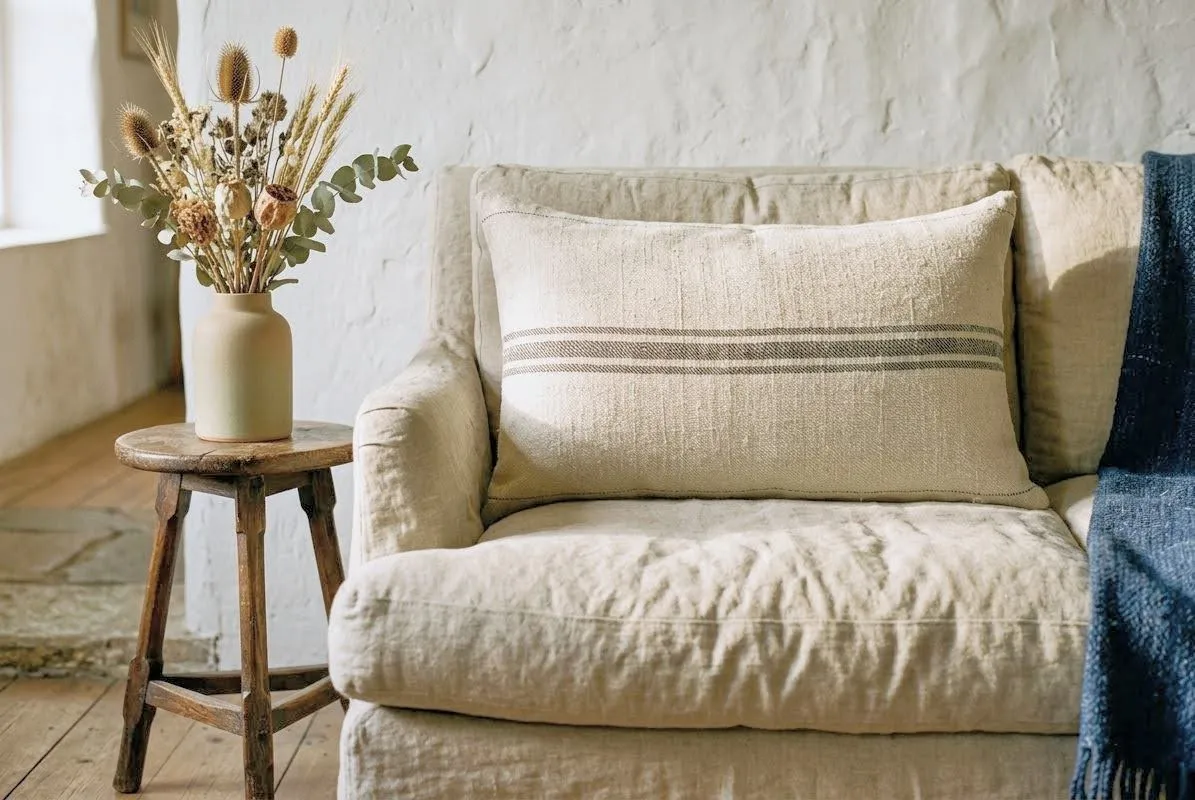
Transylvanian grain sacks are 100% hemp, hand-spun and hand-woven at home in a dense 4-shaft twill, and were still being made this way in the 1950s. French grain sacks are typically linen (flax), spun finer — increasingly by machine after 1810 — and woven flatter and tighter, with embroidered monograms instead of bold woven stripes as the main identifier. Both are authentic antiques, but they are different textiles with different histories: one is the last survivor of a fully manual household craft, the other an early product of Europe’s industrial age.
Two sacks, two Europes
Put a Transylvanian grain sack next to a French one and you are looking at two different centuries — even when they were made in the same decade. In Western Europe, flax spinning was mechanised early: Philippe de Girard patented his flax-spinning machine in 1810, and by the mid-1800s industrial mills in northern France were producing linen yarn at scale. A French farm sack from 1880 was very often sewn from mill-spun linen — even when the weaving itself was still done at home or by a village weaver.
In Transylvania, nothing of the sort happened. Hemp was grown at the edge of the village, retted in the still waters of rivers, lakes and village ponds, broken, combed, spun on a distaff and woven on the household loom — every step by hand, almost always by women. Ethnographic research in the Apuseni Mountains documents this unbroken chain from plant to finished cloth continuing well into the twentieth century, decades after Western Europe had moved on. That is why a Transylvanian sack woven in 1930 can be more “archaic” — thicker yarn, heavier cloth, more irregular texture — than a French sack woven in 1860.
The comparison at a glance
| Transylvanian grain sack | French grain sack | |
|---|---|---|
| Fibre | Predominantly 100% hemp; later pieces (c.1945–1960) cotton warp + hemp weft | Linen (flax), hemp, or linen–cotton blends |
| Yarn | Thick, hand-spun, irregular, with visible slubs and occasional plant flecks | Finer, more even — increasingly mill-spun after 1810 |
| Processing | Fully manual, plant to thread, within the household | Semi-industrial: machine-spun yarn, often hand- or workshop-woven |
| Weave | Dense 4-shaft twill — diagonal or herringbone, equally common | Typically flatter, tighter weave; plain weave frequent |
| Base colour | Natural yellow-oatmeal — sacks were never bleached | Creamier whites, greys, caramels; linen retted paler |
| Identification | The woven stripe itself — each family’s own pattern, huge variety of widths and colours | Embroidered or stamped monograms (initials, sometimes dates); stripes more standardised, classic red or blue |
| Usual size | Roughly 50×120 cm (20×47 in) | Similar range, roughly 48–55 cm wide × 100–130 cm long (19–22 × 39–51 in) |
| Closure | Open top, tied with hand-twisted hemp cord | Open top with ties; some sacks have a grain spout at one corner |
| Weight | A full sack weighs 500 g – 1 kg — the hand-spun twill is dense | Noticeably lighter for the same size; finer yarn, flatter cloth |
| Made until | Hand production continued into the 1950s; in remote villages, longer | Home linen weaving faded by the late 1800s; jute and industrial cotton sacks took over by the early 1900s |
Fibre: hemp country, flax country
The single deepest difference is the plant — and it follows the map of Europe. France, Belgium and the Netherlands were flax country: the climate of the north is among the best in the world for growing flax, and France still produces around three quarters of the world’s quality linen fibre today. Linen was the prestige fibre, and it went into everything from sheets to sacks. Transylvania, Hungary, Slovakia and the wider Carpathian region were hemp country: the crop grew in every village, produced more fibre per hectare, and was the working fibre of the household — the coarse, strong thread for sacks, and a finer bleached thread for towels and linens.
This is why so many antique dealers label everything “antique linen.” In the old sense of the word, they are not wrong — “linen” has long meant handwoven household cloth of any bast fibre, the way we still say bed linen. Transylvanian hemp sacks are often sold as “antique linen” — the term buyers search for. But the fibre itself tells a more precise story, and it is worth reading.
How we actually tell hemp from flax
Here is an honest secret of the antique textile trade: hemp and flax are botanical cousins, and after a century of washing they can look remarkably alike. A burn test — which we perform on every textile we document — proves the cloth is pure plant fibre, with no synthetics. But it cannot separate hemp from flax: both are bast fibres and burn identically. Anyone who tells you otherwise is repeating a myth.
What separates them is the character of the yarn — the same criteria textile conservators and experienced dealers use. Hemp yarn is thicker and less uniform than flax, with slubs and small irregularities; flax spins finer and more evenly. Hemp cloth is heavier in the hand and matte; linen carries a subtle, cool, almost silvery sheen. Pull a loose thread from a worn edge: hemp frays into fibrous bundles, flax stays compact. And behind all of it stands the regional record — in Transylvanian villages, hemp, not flax, was the fibre families grew. The only absolute certainty is a microscope at 40–100× magnification, the method used in historic textile conservation. We identify our pieces the way conservators do: by yarn character, weight, weave and documented origin — and we describe them exactly as we find them. If you want the full authentication method, our Buyer’s Guide to authentic grain sack pillows walks through it step by step.
The yarn: what your hands feel first
Run your palm over a Transylvanian sack and you feel the woman who spun it. The thread is thick and alive — slubs, small knots, sometimes tiny flecks of the hemp stalk still caught in the weave. This was the coarse working yarn, spun for strength, not beauty; the fine, even thread was saved for festive shirts and dowry linens.
A French linen sack feels different: flatter, smoother, tighter. Once mill-spun yarn became available, even home weavers bought it — the thread is more regular, the cloth more uniform. It is beautiful in its own right, and it is genuinely antique. But it carries less of the hand in it. The irregularity of Transylvanian cloth is not a flaw; it is the fingerprint of manual spinning, and it is exactly what reproductions cannot fake.
Stripes and monograms: two languages of ownership
Both traditions solved the same problem — how do you find your sack among fifty others at the communal mill? — in two different languages.
In Transylvania, the answer was woven in: the stripe was the family’s signature. Each household had its own combination of widths, spacings and colours, and the weaver added her own artistic sense on top. The result is an extraordinary variety — reds, burgundies, blues, teals, blacks, browns — with no two patterns alike. The wide red stripes of our Székely Collection are one regional dialect of this language; the pieces in the Valley Collection, each documented to a named river valley, speak others.
In France, stripes existed too — most classically one or two red or blue bands down the centre — but the personal identifier was usually stitched on afterwards: embroidered initials in red cross-stitch, sometimes a date or a stamped name. French sacks are prized precisely for these monograms. The convention was not exclusively French: German and Hungarian households marked their sacks the same way, which is why an occasional Transylvanian sack from a Hungarian village carries an embroidered monogram of its own — perfectly authentic, just a different dialect again. On the sacks of Romanian villages, though, the stripe did all the talking. When you see the modern “grain sack style” — one wide centre stripe flanked by two thin ones, repeated endlessly on reproduction fabric — you are looking at a flattened memory of the French pattern, not the Transylvanian one. We wrote about why that monotony is itself a warning sign in the Complete Guide to grain sack cushions.
Rescued, Not Reproduced
Every Medreana cushion cover is cut from an antique Transylvanian grain sack — hand-processed hemp, hand-woven circa 1900 in a 4-shaft twill, identified by the criteria conservators use. Each piece is documented to its region of origin, restored by hand in our atelier, and never restocked. Made once, by hand, over a century ago.
Weave and weight: why the Transylvanian sack is heavier
Transylvanian sacks were woven almost exclusively in 4-shaft twill — either a uniform diagonal, like denim, or a herringbone that reverses direction into a zigzag. Both are equally common. Twill was an engineering choice: the interlacing distributes stress across more threads, so the cloth resists tearing under the weight of grain. Combined with the dense hand-spun yarn, it produces a heavy fabric. A full antique grain sack — roughly 50×120 cm (20×47 in) — weighs between 500 g and 1 kg. A cushion cover sewn from it is naturally lighter, but still noticeably denser and heavier than any reproduction of the same size.
French linen sacks, woven from finer yarn and often in plain weave, are flatter and lighter in the hand. Again — not inferior, just different. Linen drapes; hemp stands. It is one of the reasons the two textiles style so differently in an interior, something we explore across nine rooms in How to Style Antique Grain Sack Cushions.
How they were washed, kept — and why they survived
Neither textile survived by accident. In Transylvanian households, hemp cloth was washed with wood-ash lye — hot water poured through ashes, the natural forerunner of soap — rinsed in the creek and dried in full sun, a cycle that slowly softened and lightened the cloth without weakening it. Sacks lived a working life at the mill and in the barn, and when the harvest economy changed, they were folded away in dowry chests and attics. That is where we find them: cloth left sleeping in the attics of many homes, often for half a century or more.
French sacks survived a similar way — sturdy enough to outlive their purpose, too good to throw away. But the supply is older and thinner: because home production ended earlier in France, most surviving French sacks date from the nineteenth century, and the trade in them has been picked over for decades. Transylvania’s later timeline means pieces from circa 1900 — and honest, documented later pieces too — still surface here, in the villages where they were made. If you own either, treat it gently: our Care Guide covers washing antique hemp today, and the FAQ answers the most common questions.
When production ended — and what that means for authenticity
In France, the timeline is compressed. Mechanised flax spinning arrived in 1810; by the second half of the nineteenth century, industrial mills had made home-spun linen uneconomical, and by the early twentieth century cheap jute and industrial cotton sacks had replaced linen ones almost entirely. The French grain sack is essentially a nineteenth-century object.
In Transylvania, the household loom kept working. Hemp was grown, retted in the still waters of rivers, lakes and village ponds, spun and woven by hand into the 1950s, and in remote mountain villages the full traditional process survived even longer — researchers were still recording it from living practitioners at the end of the twentieth century. Romania remained Europe’s largest hemp grower until 1989. So a Transylvanian sack from circa 1900 sits inside a living tradition, not at the end of one: the same hands, the same waters, the same looms, for another two generations.
For a buyer, the practical meaning is this: both French and Transylvanian sacks are authentic antiques, and both are worth owning. But they should be described honestly and priced accordingly — authentic pieces of either origin sell in the €75–€160 range and above, and anything under €50 labelled “antique” deserves suspicion. What no reproduction, and honestly no French sack either, can offer is what defines our Heritage and Valley pieces: hand-processed hemp identified the way conservators identify it, a weave you can read, and a named place of origin. It is a very old idea that has suddenly become fashionable again — the trend now has a name, as we wrote in our piece on folklectic decor — but for the women who wove these sacks it was never a trend. It was Tuesday.
Rescued, Not Reproduced.