
Medreana · Transylvania · Since 2013 ·
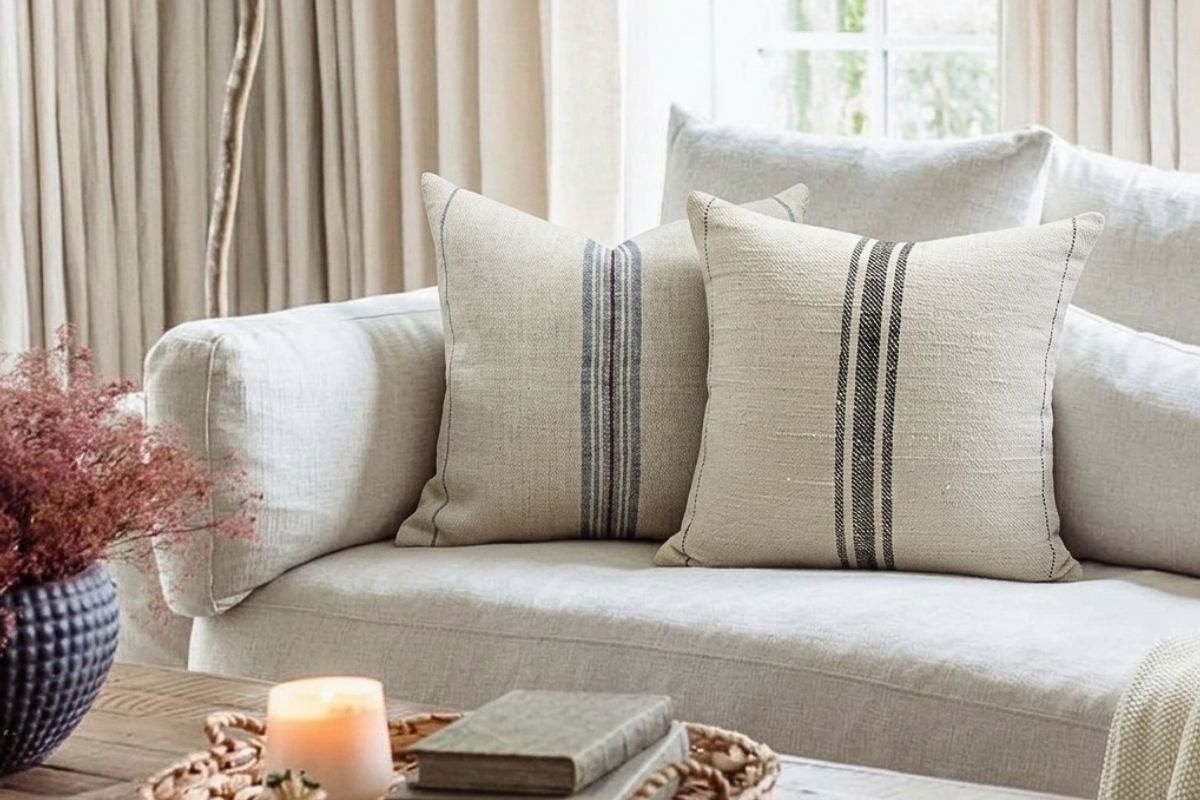
The hemp for these grain sacks cushions was grown in Transylvania, retted in cold river water, spun and woven by hand on primitive wooden looms. The stripes were the family’s signature, how they identified their grain sacks at the communal mill during harvest. None of this was decorative. All of it was necessary.
And yet here they are: antique grain sack cushions in Japandi apartments in Berlin, English farmhouses in Devon, stone houses in Puglia, Scandinavian cottages facing the Baltic. The same textile, the same oatmeal hemp, the same woven stripes. Working in all of them.
The oatmeal is not really a colour. It’s undyed hemp , warm and slightly irregular, somewhere between cream and straw depending on the light. It belongs to no particular palette, which means it clashes with none of them. And the stripes, a single, double or grouped woven line on a neutral ground, are one of the oldest patterns humans have ever made. They have never belonged to one style, one period or one culture. They are elemental. They are everywhere.
These two qualities, the neutral hemp fibre and the simplicity of the woven stripes, make antique grain sack cushions adaptable to every interior on this list. Not because they’re versatile in the marketing sense. Because they’re honest in the material sense.
This is a guide to nine interiors that welcome antique grain sack cushions — and an account of why.
Table of Contents
1. Antique Grain Sack Cushions in a Wabi-Sabi Interior
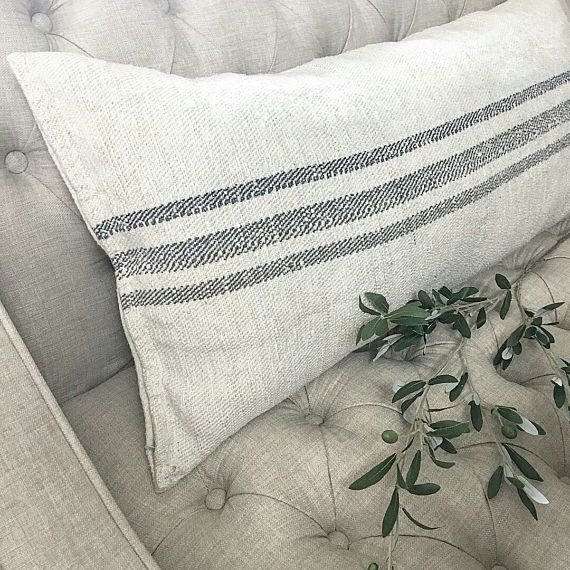
Wabi-sabi is not a decorating style. It is a philosophy: the finding of beauty in imperfection, in age, in transience, in the thing that was made by hand and shows it. Every antique grain sack cushion is, in the most literal sense, a wabi-sabi object. The variations in yarn thickness and of the weave density are not inconsistency. They are the marks of a human hand working a century ago in a farmhouse in Transylvania. They are the entire point.
In a wabi-sabi interior, the grain sack cushion needs nothing around it that competes. A natural linen sofa in undyed fabric, a worn wooden bowl on the coffee table, a single dried branch in a ceramic vessel. The oatmeal hemp provides warmth without colour noise. Its texture, rough to the touch and softened by a hundred years of use, adds the tactile dimension that defines the wabi-sabi home.
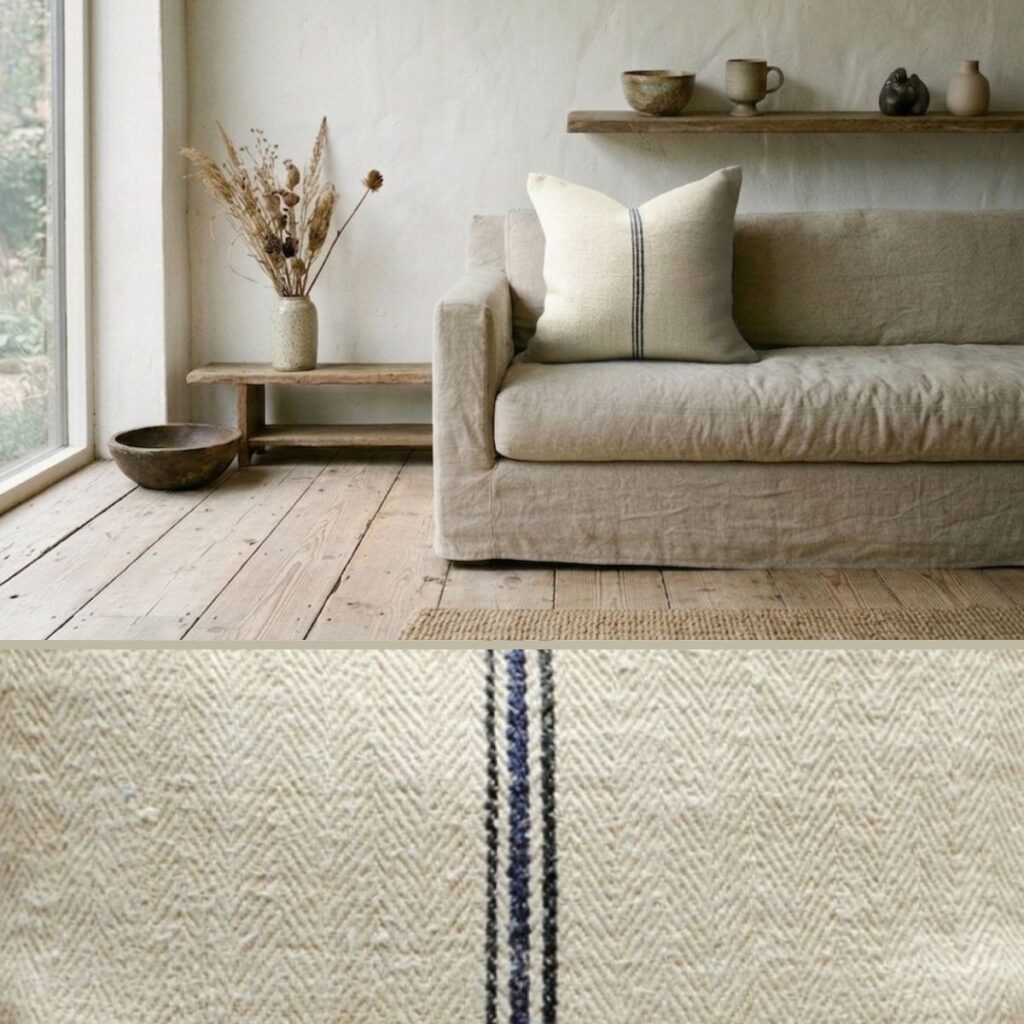
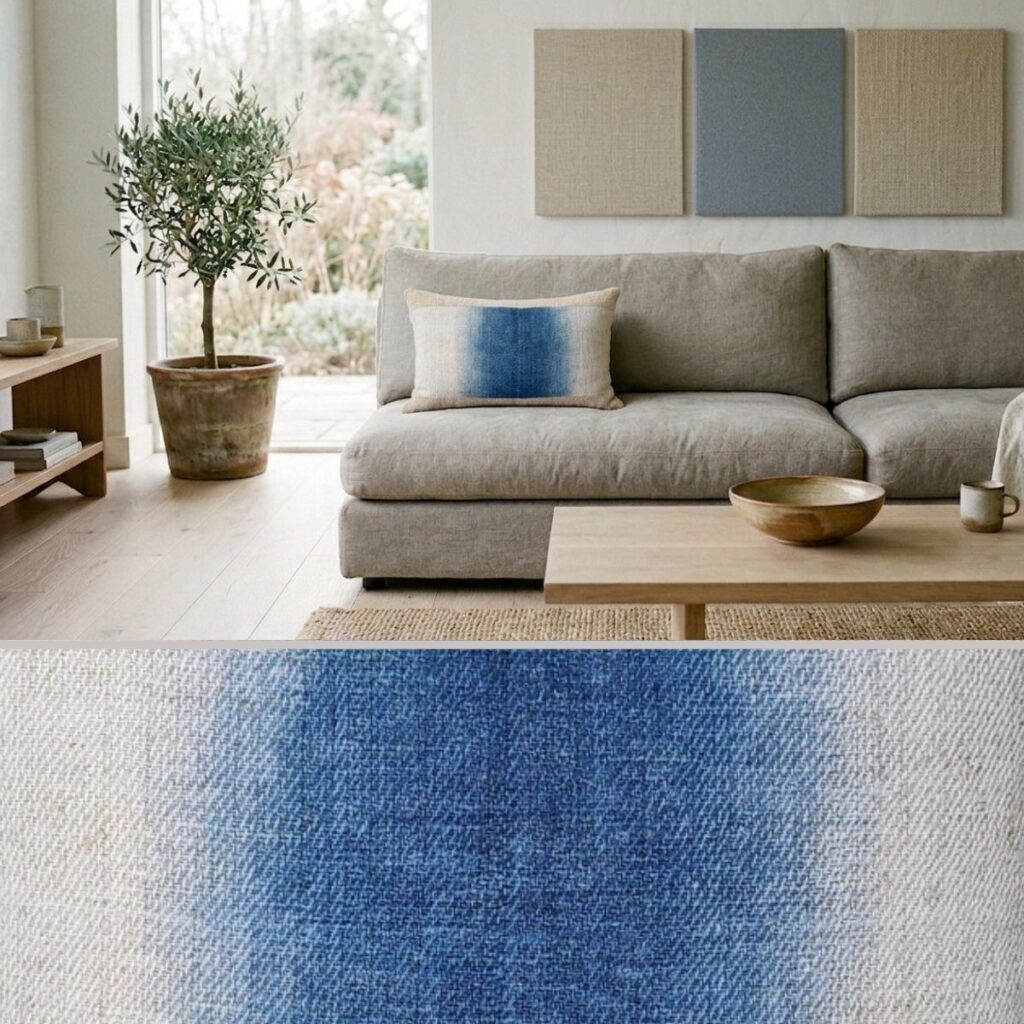
- The choice: textured cushions with no stripes or single thin line in charcoal or indigo; or the indigo dip-dye ombré from The Dyed Collection, where the gradient fades from deep blue at centre to almost nothing at the edges, the result of partial immersion rather than uniform dyeing.
- The look: Lumbar on an undyed linen bed or one square cushion on a low chair. Not both.
2. How to Style Grain Sack Cushion Covers in a Japandi Interior
Japandi is wabi-sabi’s more controlled cousin. Where wabi-sabi embraces the fraying edge and the threadbare, Japandi edits carefully: clean lines, a curated palette, materials chosen for both their beauty and their function. The result is an interior that feels simultaneously minimal and deeply warm.
The antique grain sack cushion enters the Japandi interior through material logic: hemp is a plant fibre with no industrial history. It was grown, processed by hand and woven into something useful. In a design philosophy that distrusts the disposable, a century-old textile rescued from a Transylvanian barn fits naturally. The oatmeal tone of the natural hemp sits in the Japandi palette, warm whites, pale oak, soft grey. neither adding colour nor removing warmth. The geometric simplicity of the woven stripes provide graphic interest without decoration.
- The choice: single thin indigo or charcoal stripes on oatmeal (Heritage Collection). The indigo ombré also works — organic gradient speaks directly to the Japanese sensibility for nature-derived asymmetry.
- The look: one grain sack lumbar cushion against white linen bedding on a platform bed, beside a pale oak nightstand with one ceramic cup and one small plant. Nothing more. In the living room: one square grain sack cushion cover on a low linen sofa, one wooden bowl, natural light. The Japandi home does not allow objects that cannot justify their presence. The grain sack, a century old, woven with purpose, irreplaceable, justifies itself completely.
3. Grain Sack Cushions in a Scandinavian Interior
Scandinavian design is built on two tensions held in balance: the rigour of minimalism and the warmth of hygge. The long Nordic winters produced both: an aesthetic of clean, white surfaces and maximum light and an emotional need for warmth, softness, candlelight, wool blankets and the sense of a home that holds you.
The antique grain sack cushion satisfies both simultaneously. Its geometric stripe is clean and simple, one or two thin lines on a neutral ground, exactly the restrained graphic quality that Scandinavian design favours. Its texture, the irregular hand-spun hemp surface, provides the warmth and tactile dimension that prevents a Scandinavian room from feeling cold. The oatmeal hemp, neither stark white nor warm beige, sits precisely in the colour register that Nordic interiors seek.
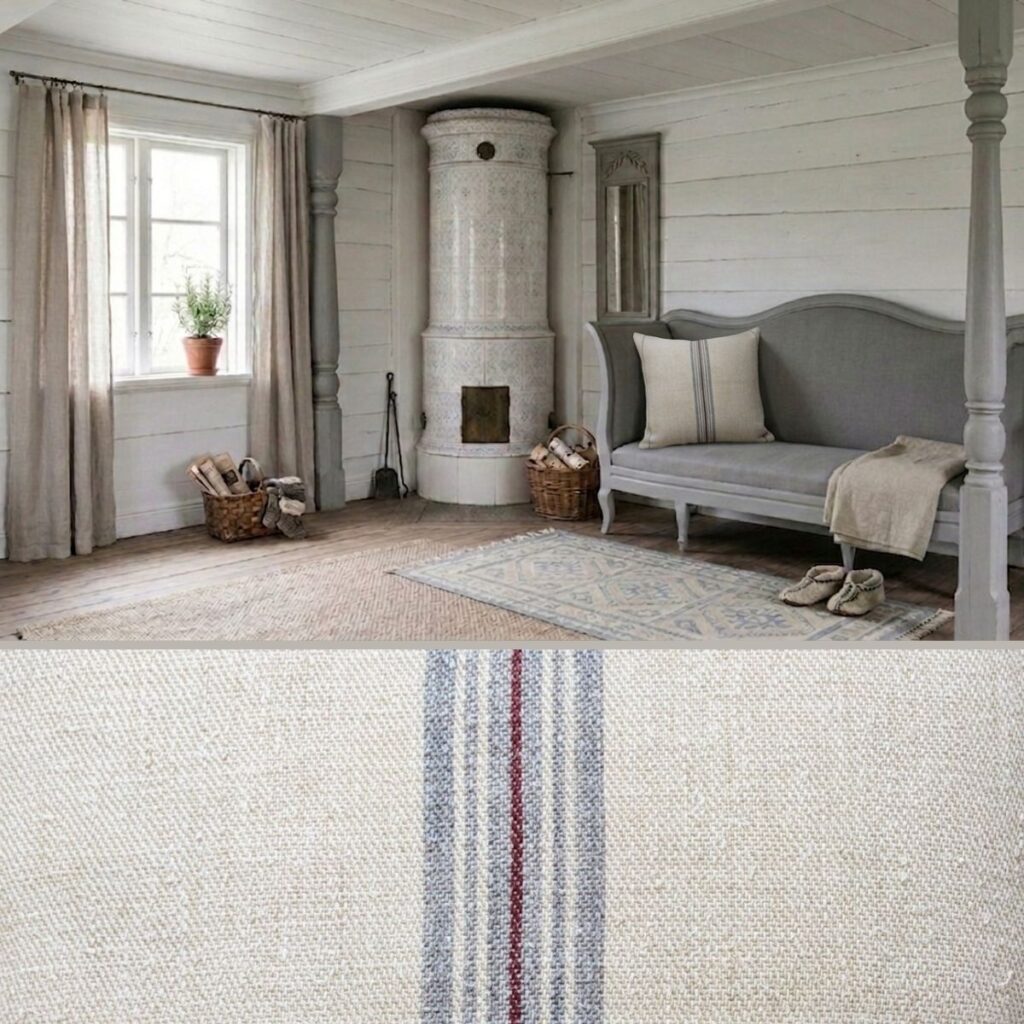
The Gustavian variation of Scandinavian style, painted white furniture, pale plank floors, ceramic tile stoves from the eighteenth century, has an especially close affinity with the grain sack. Two objects from the same century, the same agricultural world, the same honest material culture.
- The choice: thin single or double indigo stripes on oatmeal (Heritage Collection). The wide red Székely stripe is too warm for a pure Scandinavian palette.
- The look: a grain sack lumbar cushion on a bathtub sofa upholstered in natural linen, against a wall of white-painted planks. Add a sisal rug, a single ceramic lamp, diffused northern light. For the bedroom: a square grain sack cushion cover on a white iron bed, one bare branch in a glass vase beside it.
4. Antique Grain Sack Cushions in an English Country House
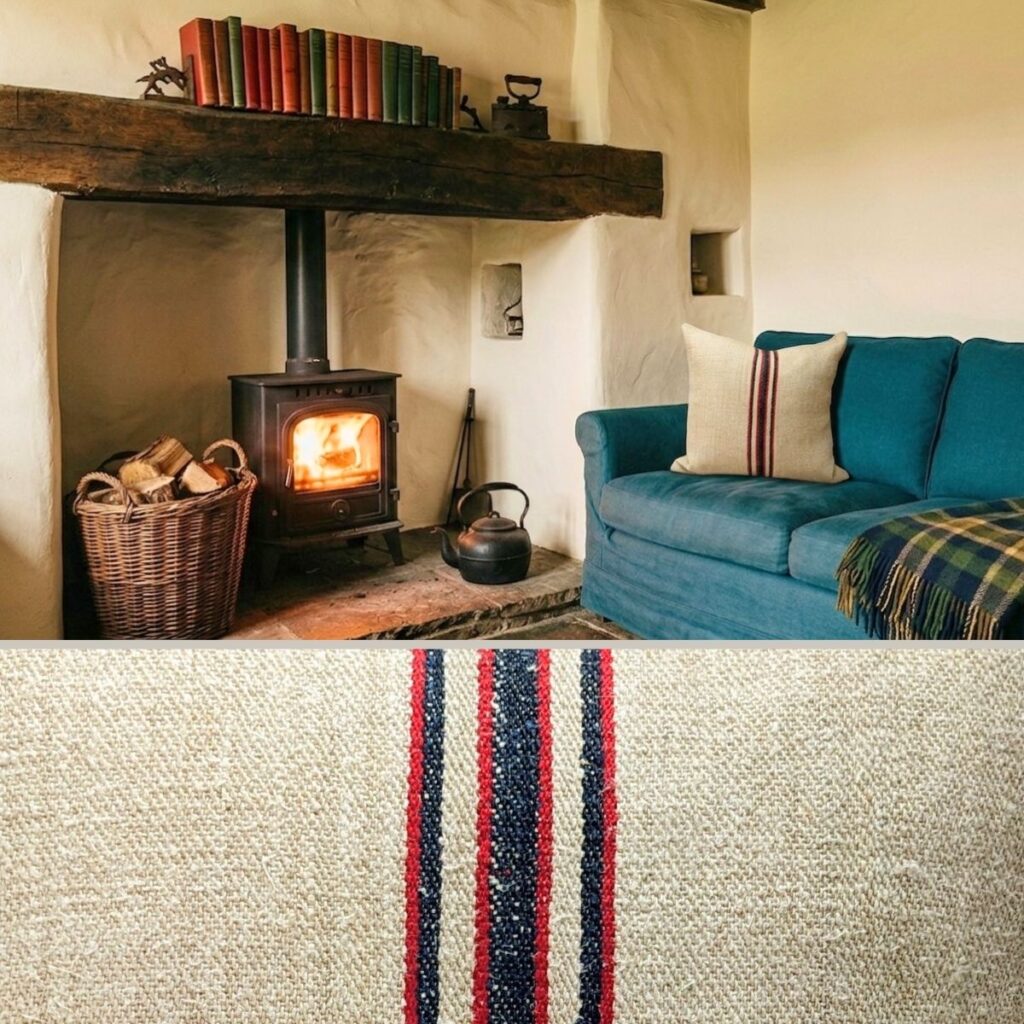
The English country house interior is built on accumulation, not curation. Nothing in it was chosen in a single afternoon from a single catalogue. The oak table came from a sale at a neighbouring estate. The needlepoint cushion was worked by someone’s grandmother. The linen sofa has been re-covered twice and will be re-covered again. Into this world of flagstone floors, cast iron log burners, oak beams and deep-set sash windows, a grain sack cushion from Transylvania arrives naturally. Not because it matches anything, but because it comes from the same tradition: working textiles made by hand from grown fibre, built to last.
- The look: The styling principle for this interior is deliberate imprecision. One grain sack lumbar cushion on a loose-covered linen sofa, slightly angled. A wool throw in warm oatmeal draped casually over the arm. A worn wooden stool beside the sofa with a ceramic cup and a small stack of books. English country interiors distrust perfection. The cushion that is too symmetrically placed, the arrangement that looks staged. The antique grain sack cushion, with its handwoven irregularity and its century of history, never looks staged.
- The choice: oatmeal hemp with single or double indigo blue stripes (Heritage Collection) in lumbar format. Or, for houses where a warmer note is welcome, the bold red stripes of the Székely Collection — the agricultural vocabulary of Eastern Europe reading fluently in the visual language of the English countryside.
5. French Country Cottage and Antique Grain Sack Cushions
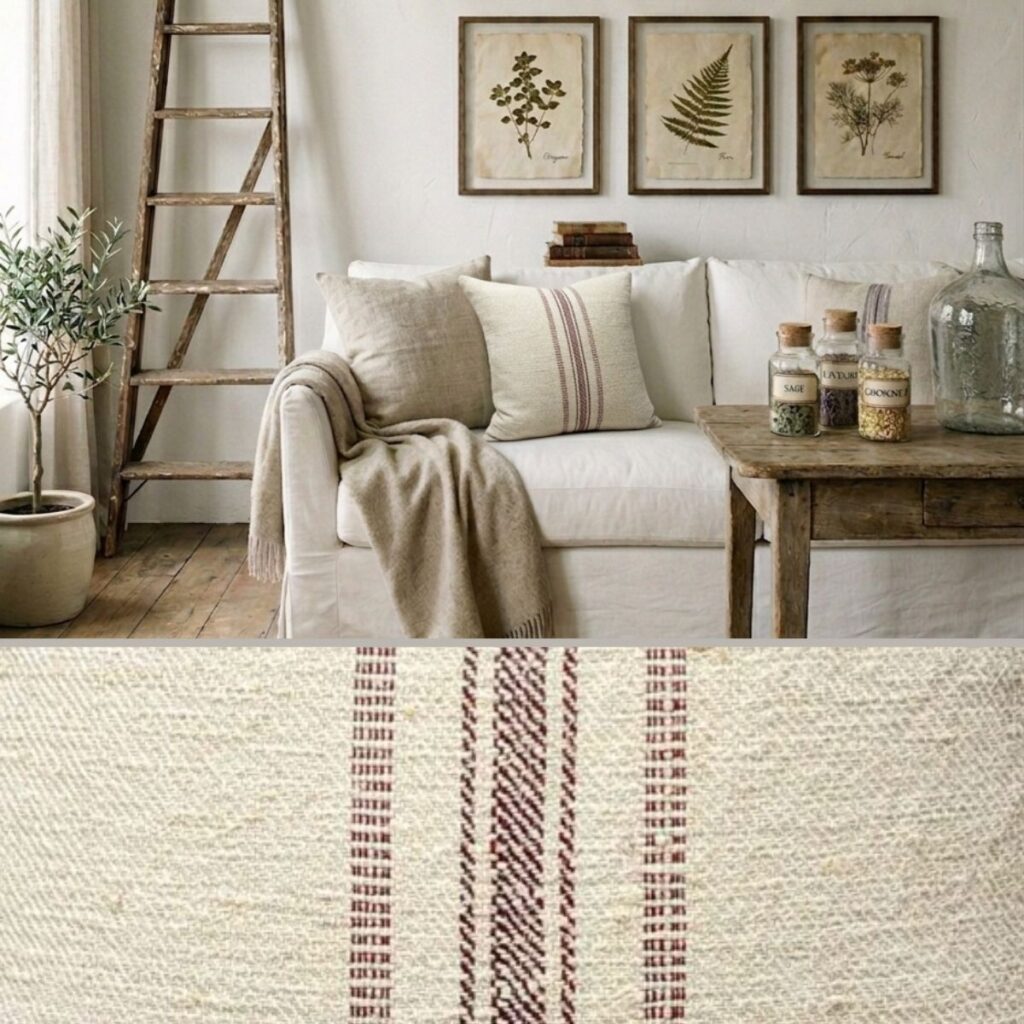
The French countryside speaks in a particular register: stone floors worn smooth by centuries, plaster walls in the palest cream, linen curtains moving in warm afternoon air, a long table set simply with earthenware and linen napkins. Antique textiles are not decoration in this interior. They are evidence of a life lived slowly, of objects chosen for their authenticity, of a home that has taken decades to become itself.
The finest French country interiors do not look decorated. They look collected. A kilim found at a market in Avignon. A bench discovered at a brocante. A grain sack cushion cover rescued from a barn in Transylvania. Each object arrived separately, over time, and settled in as if it had always been there. The oatmeal hemp, warm, undyed, naturally textured. belongs to the French country palette as directly as limestone and linen.
- The choice: grain sack cushion covers in faded red or soft burgundy stripes (Heritage Collection) with a linen sofa in warm oatmeal or aged white. The palette should feel sun-bleached: nothing too saturated, nothing too new.
- The look: in the dining room, a grain sack lumbar cushion on a painted wooden chair at a long table set with earthenware and wildflowers. One square cushion on a linen bed, a pot of dried lavender on the stone windowsill.
6. Grain Sack Cushion Covers in a Mediterranean Farmhouse
From the masserie of Puglia to the fincas of Mallorca, from the konobe of Dalmatia to the bergeries of Provence, Mediterranean interiors share a vocabulary built from the same materials as the landscape itself. Thick walls of stone that hold the cool. Terracotta floors warm from the afternoon sun. Plaster walls in the palest off-white, textured by hand. Objects that have survived generations because they were made to last.
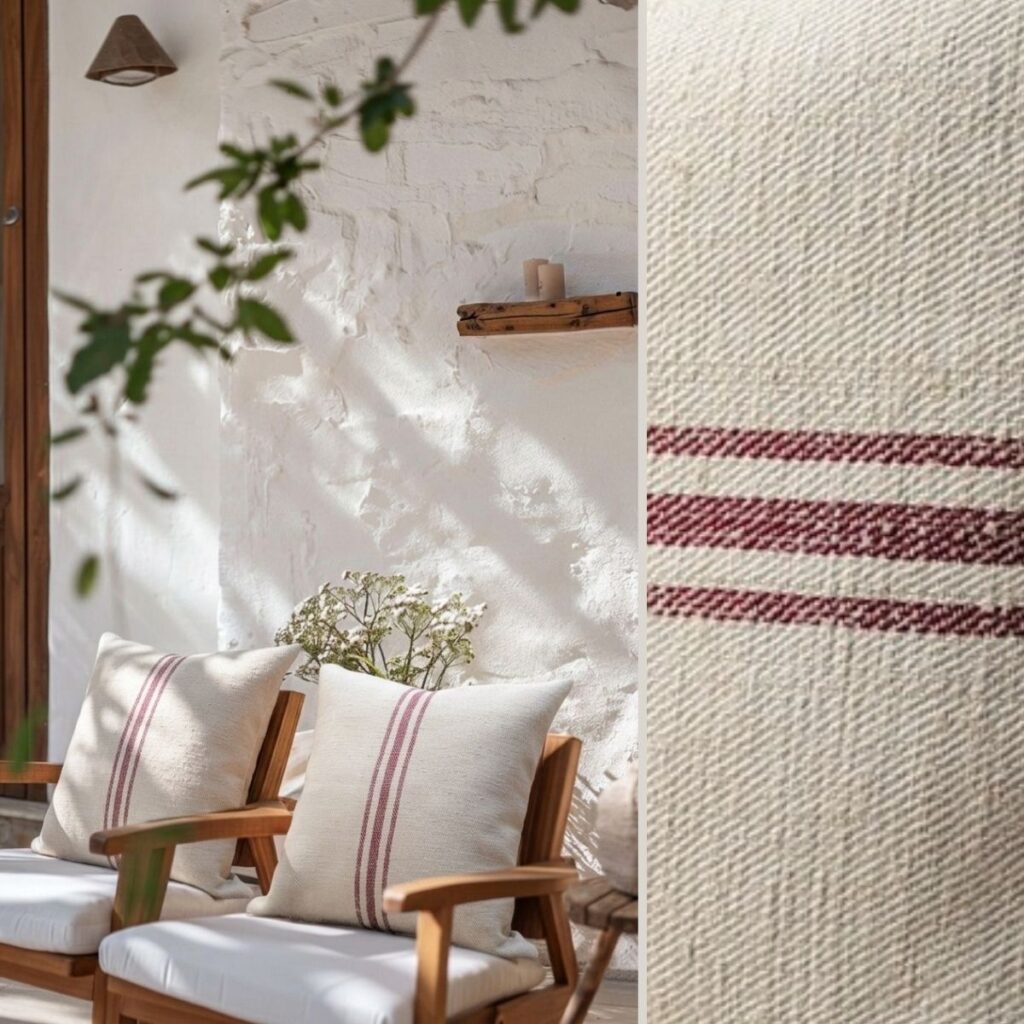
A grain sack cushion, woven from hemp a century ago in Transylvania, speaks this language.. Hemp is a Mediterranean crop as much as a Transylvanian one: the same plant, the same fibre, the same agricultural purpose. The oatmeal tone of the natural ground reads as warm and earthy under Mediterranean light in a way that contemporary fabrics cannot replicate. The stripe, simple, woven, permanent, echoes the geometric patterns found in traditional tiles, woven baskets and hand-painted ceramics throughout the Mediterranean world.
- The choice: the coral overdyed cushion covers from The Dyed Collection, the terracotta tone echoes the fired clay of Mediterranean floors and roofs. Oatmeal with warm red or burgundy stripes from the Heritage Collection for a quieter version.
- The look: on a stone terrace, grain sack lumbar cushions on wooden chairs alongside terracotta pots and olive branches in ceramic vessels. In a living room with stone floors and whitewashed walls: a square cushion in natural oatmeal with a warm red stripe, one large ceramic lamp, a linen throw in undyed natural. The composition is the contrast: rough-textured hemp against warm stone or plaster, the tactile richness of two ancient materials in the same room.
7. Antique Grain Sack Cushions in a Rustic European Farmhouse
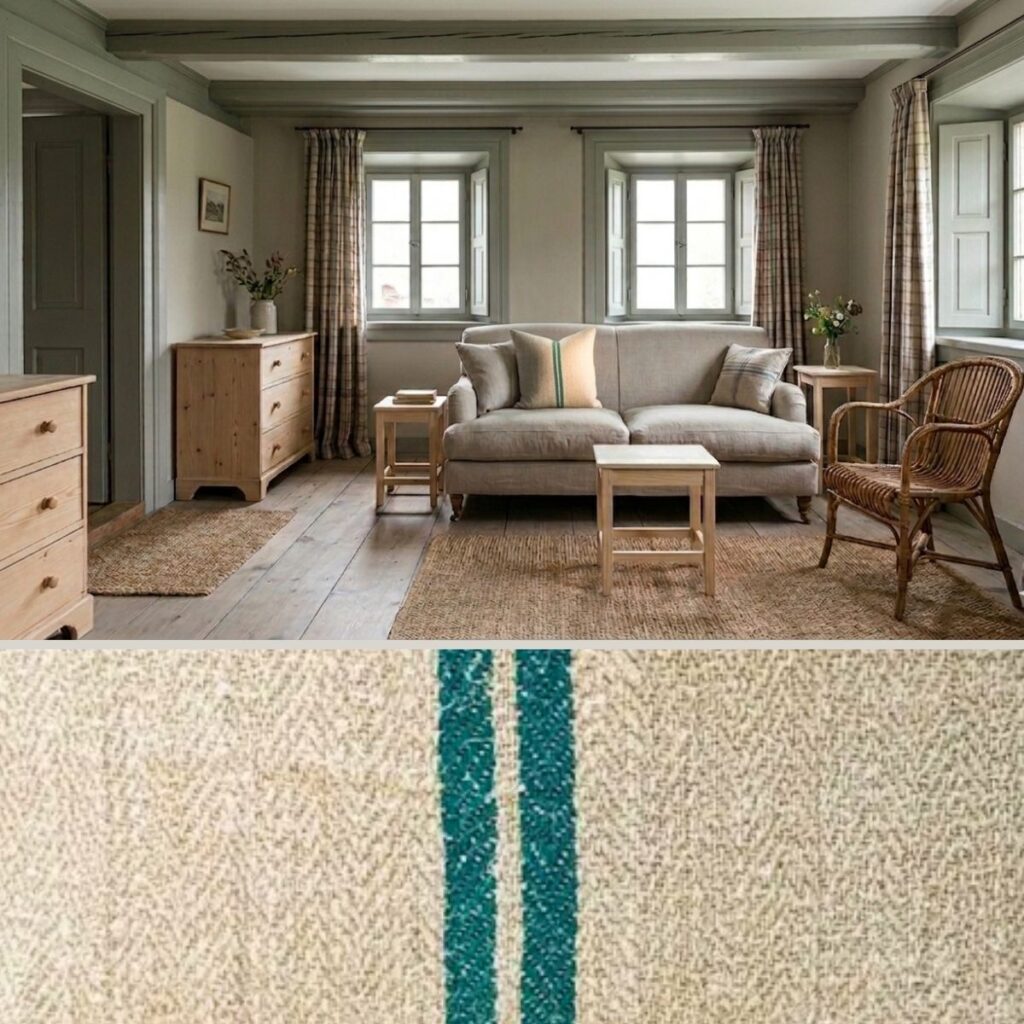
The European farmhouse is not a style. It is a building type: a structure raised in the sixteenth or seventeenth century for agricultural life, adapted over centuries to the needs of the families who lived in it. In Germany, Austria, Switzerland, the farmhouse means thick timber beams, wide plank floors, plaster walls in warm neutral tones, a tile stove in the corner, shuttered windows facing the mountain or the valley. The beauty is not designed. It is accumulated.
This is crucial for understanding where the antique grain sack cushion sits here: it does not decorate the room. It belongs to the same cultural world as the room. The hemp textile of Transylvania and the timber farmhouse of Bavaria are products of the same agricultural civilisation, the same century, the same material honesty. The oatmeal hemp against the warm plaster of an Alpine wall, the woven stripe beside an oak beam: there is no incongruity. Everything is speaking the same language.
- The choice: Heritage Collection or Valley Collection in oatmeal with indigo or charcoal stripes. For the more expressive Alpine version, the wide red stripes of the Székely Collection, the colour of the traditional painted furniture found throughout the German-speaking alpine farmhouse.
- The look: a grain sack lumbar cushion on a wooden bench beside a tile stove (Kachelofen). A square cushion on a linen armchair near a window overlooking an alpine meadow. The material sincerity of century-old handwoven hemp is exactly what the European farmhouse interior demands and deserves.
8. Styling Grain Sack Cushion Covers in an Industrial Interior
Industrial design has its own origin story: the workers and bohemians of 1930s America who settled in abandoned factories and came to appreciate the austere beauty of what they found there. High ceilings. Brick walls. Metal pipes. Concrete floors. Huge windows. The aesthetic of honest utility, nothing hidden, nothing pretended.
The antique grain sack cushion follows the same logic. It too was made for pure utility, with no concession to decoration. The stripe was not ornamental, it was a means of identification. The hemp was not chosen for its beauty, it was chosen for its strength. Both the industrial interior and the antique grain sack arrive at beauty through the same route, by doing their job.
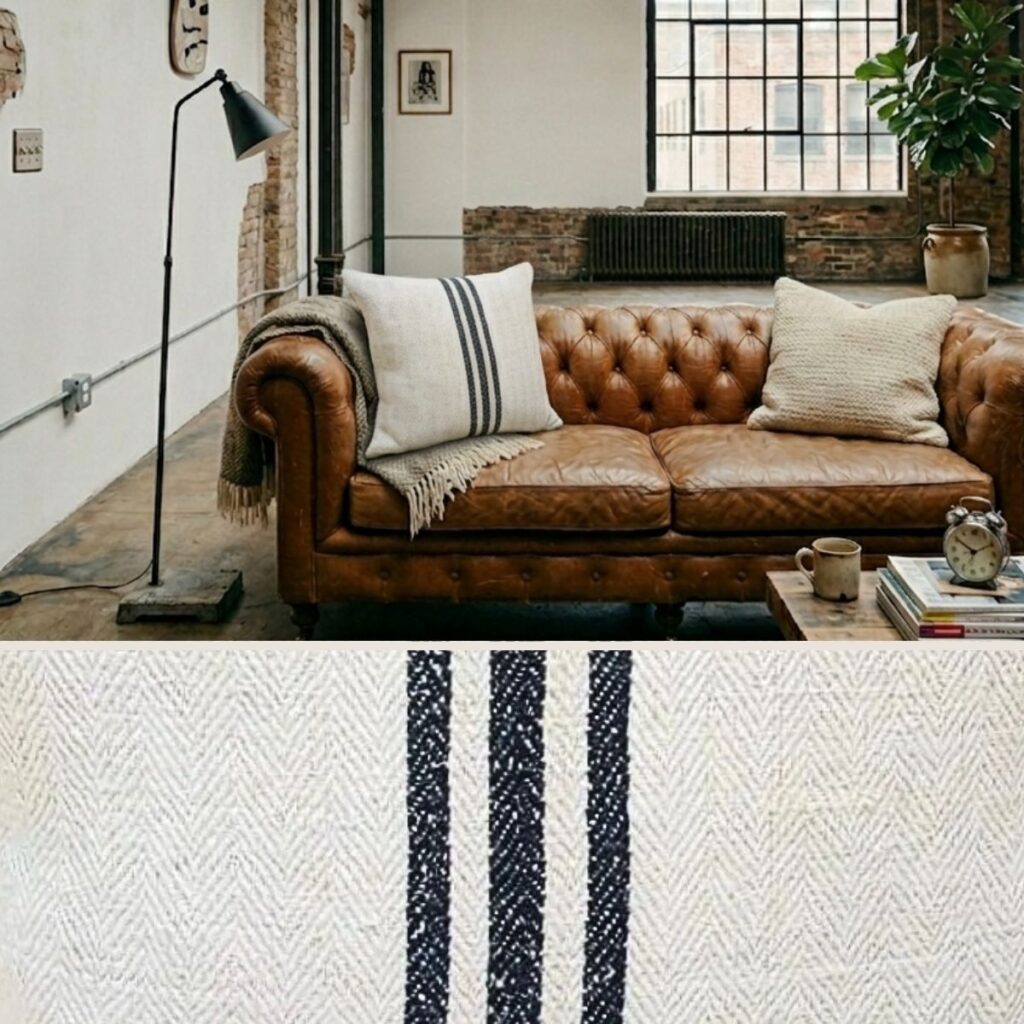
In an industrial loft with exposed brick and leather furniture, the grain sack cushion provides the one element the interior most needs: organic warmth. The handspun hemp and the worn brick share the same material honesty. The slubs and irregularities of a hand-spun thread are the soft counterpoint to concrete and metal. The oatmeal ground brings the only warm neutral in a palette of grey, black and rust. The stripes, geometric, simple, woven rather than printed, read as industrial graphic without being a reproduction of one.
- The choice: charcoal or black stripes on oatmeal hemp, the most graphic, architecturally combination (Heritage Collection). Or the Dyed Collection, the gradient of natural dye absorption on handloomed hemp, organic and geometric simultaneously.
- The look: one or two substantial cushions on a leather sofa or Chesterfield armchair. Nothing sentimental. Nothing unnecessary.
9. Antique vs. Reproduction: Grain Sack Cushion Covers in a Modern Farmhouse
The Modern Farmhouse aesthetic emerged in the 2010s as a response to the sterility of contemporary minimalism, a search for warmth, texture and a sense of rootedness that mass-produced interiors could not provide. Shiplap, open shelving, reclaimed wood accents, black iron fixtures: the vocabulary is well established and immediately recognisable.
Within this context, the antique grain sack cushion makes a case that is worth stating plainly: there is a significant difference between a grain sack cushion and a grain-sack-style cushion. The former is a century-old hemp textile, hand-woven in Transylvania, carrying the specific stripe signature of a specific family, irreplaceable and unrepeatable. The latter is a printed pattern on industrial cotton. The look is there. The history isn’t.
The oatmeal is the same colour. The stripe is approximately the same width. . But one is a print on cotton and one is a four-shaft twill weave in hemp that has been used through a hundred harvests. You can feel the difference with your hands.
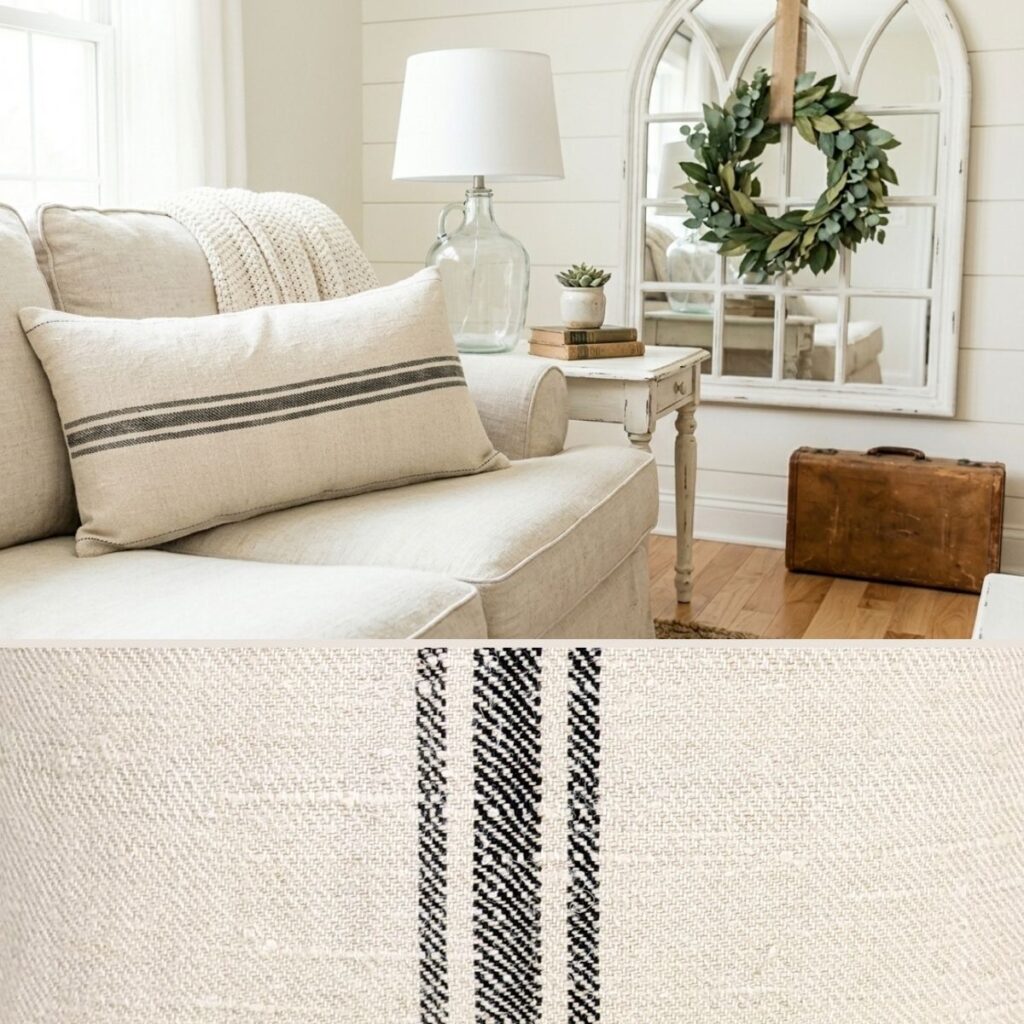
- The choice: bold charcoal or black stripes on oatmeal in Heritage Collection for the high-contrast Modern Farmhouse look. The contrast between the antique textile and the clean interior captures the essential tension of the style, old and new, rough and smooth, handmade and considered.
- The look: a lumbar cushion on a white slipcovered sofa. For the bedroom: a grain sack lumbar cushion against white linen bedding on an iron bed, the vintage textile anchoring the composition.
The Common Thread: Why One Textile Works in Nine Interiors
Nine interior styles. One textile. The reason is simpler than it might appear.
The antique grain sack cushion does not perform a style. It’s undyed, slightly irregular, warmer than white and less assertive than linen. It sits in any palette because it does not come from any palette: it comes from a plant. The stripe is the oldest pattern there is. A single line on a neutral ground predates every design movement on this list.
And beneath both, beneath the neutrality of the colour and the simplicity of the stripe, is the fact that this is a real object with a real history. It was made once, by hand, over a century ago, in Transylvania. It cannot be remade. Every interior on this list, from the spare clarity of the Japandi apartment to the accumulated warmth of the English country house, is at its best a space built around objects with prior lives. Objects that were made well, used honestly and survived.
The antique grain sack cushion is one of those objects. That is why it works everywhere.
Ready to bring a piece of authentic Transylvanian history into your home?
Every cushion featured in this guide was hand-selected by me from original grain sacks rescued from old barns and attics across Transylvania. Since 2013 we have been saving these unique textiles and transforming them into one-of-a-kind cushion covers that will never be reproduced. Because each piece is truly singular, once it’s gone, it’s gone forever.
Leave a Reply to Grain Sack Pillows & the Folklectic Trend: Why 2026 Finally Has a Name for What We Make Cancel reply